For centuries, farming has been deeply connected to the rhythm of nature. Farmers relied on their intuition, generations of accumulated wisdom, and the unpredictable whims of weather. Decisions were often made based on broad observations of fields, leading to practices like uniform irrigation across vast areas or blanket application of fertilizers. It was a laborious, often uncertain endeavor, where the margin for error could mean the difference between a bountiful harvest and financial struggle.
Today, a quiet revolution is sweeping through agriculture, transforming these age-old practices into a high-tech, data-driven industry. This shift is known as “smart farming” or “precision agriculture,” and it’s fundamentally changing how food is grown. Instead of relying solely on guesswork, modern farmers are harnessing the power of digital tools – from flying robots to tiny sensors and sophisticated software – to make incredibly precise decisions. This isn’t just about making farming easier; it’s about making it smarter, more efficient, and ultimately, more sustainable for a growing global population.
Let’s explore how these cutting-edge technologies are reshaping the agricultural landscape, one field at a time.
Eyes in the Sky: How Drones Are Revolutionizing Crop Monitoring
Imagine being able to survey every inch of a sprawling farm in minutes, identifying issues that would take days or weeks to spot on foot. This is precisely what agricultural drones are enabling. These unmanned aerial vehicles (UAVs) are far more than just toys; they are sophisticated tools equipped with advanced cameras and sensors that provide farmers with an unprecedented bird’s-eye view of their operations.
Monitoring Crop Health and Growth
One of the most significant applications of drones in smart farming is their ability to monitor crop health with incredible detail. Drones can be outfitted with various types of cameras, including:
- RGB (Red, Green, Blue) Cameras: These are standard cameras that capture visible light, much like the camera on your smartphone. They can provide high-resolution images of fields, allowing farmers to spot areas with poor growth, water stress, or visible pest infestations.
- Multispectral and Hyperspectral Cameras: These are the real game-changers. They capture light beyond the visible spectrum, including near-infrared light. Plants reflect different wavelengths of light depending on their health and growth stage. By analyzing these reflections, farmers can generate “vegetation indices” like the Normalized Difference Vegetation Index (NDVI). An NDVI map, for instance, uses a color scale (e.g., green for healthy, red for stressed) to instantly show which parts of a field are thriving and which are struggling, long before problems become visible to the human eye. This allows for early intervention, preventing widespread crop damage.
Farmers can use these detailed maps to:
- Identify areas needing more water or nutrients.
- Detect early signs of disease or pest outbreaks.
- Assess the effectiveness of existing irrigation systems.
- Estimate crop yield more accurately.
Precision Spraying and Seeding
Beyond monitoring, drones are also being deployed for operational tasks, particularly in precision application. Equipped with specialized sprayers, drones can deliver pesticides, herbicides, or fertilizers with pinpoint accuracy.
- Reduced Waste: Instead of spraying an entire field uniformly, drones can target only the affected areas identified through their mapping capabilities. This significantly reduces the amount of chemicals used, cutting costs and minimizing environmental impact.
- Access to Difficult Terrain: Drones can easily reach parts of fields that are challenging for traditional tractors, such as steep slopes or waterlogged areas, ensuring uniform treatment across the entire farm.
- Efficiency: Drones can cover large areas much faster than manual methods, saving time and labor.
The use of drones represents a leap forward, moving farmers from broad-stroke applications to highly targeted, data-driven interventions.
Watch: What is precision agriculture? UGA expert explains drones, AI and the future of ag tech
The Silent Watchers: Sensors and IoT in the Fields
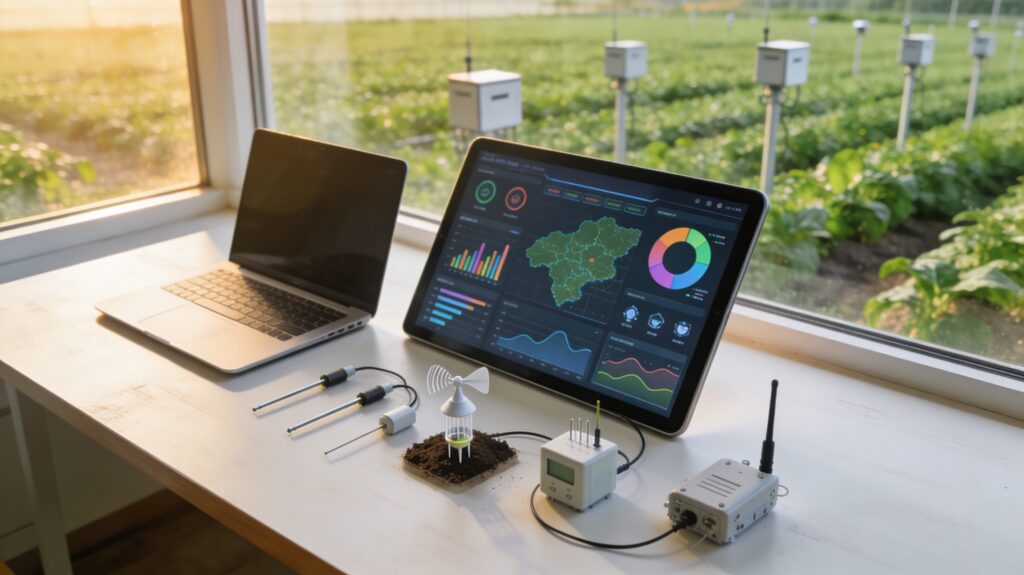
While drones provide the big picture from above, a network of silent, tireless watchers on the ground offers crucial, granular detail. These are sensors and Internet of Things (IoT) devices, scattered throughout fields and barns, constantly collecting vital environmental data.
The Internet of Things (IoT) refers to physical objects embedded with sensors, software, and other technologies for the purpose of connecting and exchanging data with other devices and systems over the internet. In farming, these “things” are specialized sensors designed to measure specific conditions.
Soil Sensors: Understanding the Foundation
The soil is the foundation of any farm, and its health directly impacts crop success. Traditional methods of soil testing often involve sending samples to a lab, which can be time-consuming and provide only a snapshot of conditions in a small area. Modern soil sensors, however, offer continuous, real-time insights:
- Moisture Sensors: These devices measure the water content in the soil at various depths. This data tells farmers exactly when and where to irrigate, preventing both under-watering (which stresses crops) and over-watering (which wastes water and can lead to nutrient runoff).
- Nutrient Sensors: Some advanced sensors can detect levels of essential nutrients like nitrogen, phosphorus, and potassium (NPK), as well as pH levels. This information helps farmers apply the right amount of fertilizer precisely where it’s needed, avoiding wasteful over-application and ensuring crops get optimal nutrition.
- Temperature Sensors: Soil temperature is critical for seed germination and root development. Sensors provide real-time data, helping farmers determine the best time for planting.
Field Sensors: Monitoring the Environment
Beyond the soil, other sensors monitor the broader environmental conditions impacting crops and livestock:
- Weather Stations: Miniature, localized weather stations placed around a farm collect data on air temperature, humidity, wind speed and direction, and rainfall. This hyper-local information is far more accurate than regional forecasts and helps farmers make timely decisions about irrigation, spraying, or protecting crops from frost.
- Pest and Disease Detection: Some innovative sensors are being developed to detect the presence of specific pests or early signs of disease through changes in air quality or plant emissions, allowing for immediate, targeted treatment.
- Livestock Monitoring: In animal agriculture, IoT sensors are used in collars or implants to monitor animal health, location, activity levels, and even reproductive cycles, improving animal welfare and farm management.
All this data is wirelessly transmitted to a central system, providing a comprehensive, real-time picture of the farm’s environment. This constant stream of information empowers farmers to move from reactive decision-making to proactive, predictive management.
Read more: Empowering Precision Agriculture with the Internet of Things, Artificial Intelligence, and Robotics
Watch: How precision agriculture helps farmers work smarter | FarmTech Quest
The Brain of the Farm: Farm Management Apps and Software
Collecting vast amounts of data from drones and sensors is only half the battle. The real power comes from turning that raw data into actionable insights. This is where farm management apps and software come into play. These digital platforms act as the central nervous system of a smart farm, aggregating information, analyzing trends, and helping farmers make informed decisions.
Data Aggregation and Visualization
Modern farm software platforms are designed to integrate data from diverse sources:
- Drone Imagery: High-resolution maps showing crop health, growth patterns, and problem areas.
- Sensor Data: Real-time readings on soil moisture, nutrient levels, temperature, and localized weather.
- Equipment Data: Information from smart tractors and other machinery, including fuel consumption, planting depth, and application rates.
- Historical Data: Records of past yields, weather patterns, and market prices.
All this information is typically displayed on an intuitive dashboard, often featuring interactive maps and graphs. Farmers can zoom in on specific fields, compare conditions over time, and visualize trends that would be impossible to discern through manual observation.
Decision Support and Automation
The true value of these platforms lies in their ability to translate complex data into practical recommendations:
- Precision Irrigation Schedules: Based on soil moisture data and weather forecasts, the software can recommend precise irrigation schedules for different zones of a field, or even automatically trigger smart irrigation systems to deliver water only where and when it’s needed.
- Fertilizer and Pesticide Prescriptions: By combining crop health maps with soil nutrient data, the software can generate variable-rate application maps, instructing smart machinery to apply varying amounts of inputs across the field, optimizing growth while minimizing waste.
- Planting and Harvesting Optimization: Analyzing historical yield data, weather patterns, and current growth conditions, the software can help farmers determine optimal planting times, estimate harvest dates, and even predict potential yields.
- Pest and Disease Alerts: Integrating data from pest traps or environmental sensors, the system can alert farmers to potential outbreaks, suggesting timely and targeted interventions.
- Financial Tracking and Reporting: Beyond agronomy, many platforms also help manage farm finances, track inventory, and generate compliance reports, streamlining the business side of farming.
These apps and software essentially provide farmers with a powerful analytical assistant, helping them move from reactive problem-solving to proactive, predictive management, maximizing efficiency and profitability.
Watch: Precision Farming Technology Explained | Smart Farming Future of Agriculture
The Payoff: Benefits of Smart Farming
The integration of drones, sensors, and software isn’t just technologically impressive; it delivers tangible, significant benefits across various aspects of agriculture.
1. Higher Yields and Improved Crop Quality
By providing precise, real-time data, smart farming allows farmers to create optimal growing conditions. Addressing issues like nutrient deficiencies or pest outbreaks early prevents widespread damage, leading to healthier crops and ultimately, higher yields per acre. Optimized irrigation and fertilization also contribute to more uniform and higher-quality produce.
2. Resource Efficiency: Less Water, Less Fertilizer, Less Pesticides
This is one of the most compelling benefits. Precision agriculture ensures that resources are applied exactly where and when they are needed, rather than uniformly across an entire field.
- Water Savings: Targeted irrigation based on soil moisture data can reduce water consumption by a significant margin, crucial in regions facing water scarcity.
- Reduced Chemical Use: Applying fertilizers and pesticides only to specific problem areas, rather than broadcasting them, drastically cuts down on the volume of chemicals used. This saves money and minimizes environmental contamination.
3. Lower Costs and Increased Profitability
While the initial investment in smart farming technology can be substantial, the long-term cost savings are significant:
- Reduced Input Costs: Less water, fertilizer, and pesticides directly translate to lower operational expenses.
- Optimized Labor: Automation and efficient data management can reduce the need for manual scouting and application, freeing up labor for other tasks.
- Maximized Yields: Higher yields from optimized conditions directly increase revenue.
- Fuel Efficiency: Smarter routing for machinery and targeted applications can reduce fuel consumption.
4. Environmental Impact and Sustainability
Smart farming isn’t just good for the farmer’s bottom line; it’s also good for the planet.
- Reduced Pollution: Less runoff from excess fertilizers and pesticides means cleaner waterways and healthier ecosystems.
- Soil Health: Precise nutrient management helps maintain soil fertility and structure, promoting long-term sustainability.
- Carbon Footprint Reduction: More efficient operations, reduced chemical production, and better soil health can contribute to a lower carbon footprint for agriculture.
- Biodiversity: Less widespread chemical use can support local biodiversity.
The Road Ahead: Challenges in Adopting Smart Farming
Despite its immense promise, the widespread adoption of smart farming technologies faces several hurdles, particularly for smaller farms or those in developing regions.
1. Initial Cost of Technology
The advanced equipment – high-quality drones, multiple field sensors, sophisticated software subscriptions, and potentially even smart tractors – represents a significant upfront investment. For many farmers, especially those operating on tight margins, this cost can be prohibitive, even with the promise of long-term returns.
2. Technical Skills and Training
Operating and interpreting data from these complex systems requires a new set of skills. Farmers and farm workers need training in drone operation, data analysis, software proficiency, and understanding the scientific principles behind the sensor readings. Bridging this knowledge gap is crucial for successful implementation.
3. Connectivity in Rural Areas
Many agricultural areas, particularly in remote regions, suffer from poor or non-existent internet connectivity. Smart farming technologies rely heavily on seamless data transmission – from sensors to the cloud, and from the cloud to the farmer’s device. Without reliable broadband infrastructure, the full potential of these systems cannot be realized.
4. Data Overload and Interoperability
Farmers can quickly become overwhelmed by the sheer volume of data generated. Furthermore, integrating data from different manufacturers’ drones, sensors, and software platforms can be challenging due to a lack of universal standards and interoperability.
5. Data Privacy and Security
As more farm data is collected and stored digitally, concerns about data privacy, ownership, and cybersecurity become increasingly important. Farmers need assurances that their sensitive operational data is protected.
Watch: The Challenges in Adopting Precision Ag
Conclusion: Cultivating the Future
Smart farming represents a pivotal moment in the history of agriculture. It’s a journey from broad-stroke farming to hyper-localized precision, driven by the incredible power of digital technology. Drones provide the aerial perspective, sensors offer ground-level insights, and sophisticated software ties it all together, empowering farmers to make decisions that were once unimaginable.
While challenges like cost, training, and connectivity are real, the momentum towards a smarter, more sustainable agricultural future is undeniable. As these technologies become more accessible and user-friendly, they will continue to transform how we grow our food, ensuring higher yields with fewer resources, protecting our environment, and ultimately helping to feed a planet that continues to grow. The future of farming isn’t just about hard work; it’s about working smart, cultivating innovation, and harvesting a better tomorrow.