Space mining often conjures images pulled straight from science fiction: colossal asteroid harvesters, fleets of automated robots extracting untold riches, and humanity’s future secured by an endless supply of extraterrestrial resources. Headlines frequently promise trillion-dollar asteroids and a new gold rush in the cosmos, painting a picture of imminent prosperity. While the idea of tapping into the vast mineral wealth of the Moon, asteroids, or even Mars is undeniably captivating, the reality is far more complex, fraught with immense engineering challenges, astronomical costs, and a nascent legal framework. For tech readers, potential investors, and curious generalists alike, it’s crucial to separate the speculative hype from the tangible progress and realistic pathways.
This article aims to cut through the sensationalism and provide a grounded perspective on space mining. We’ll explore the theoretical underpinnings, assess the current state of technology, dissect the economic hurdles, navigate the legal landscape, and consider the most plausible initial applications. By the end, you’ll be equipped to evaluate announcements and pitches with a critical eye, understanding how to think about space mining without getting lost in the dazzling, but often misleading, glow of sci-fi promises.
How Space Mining Is Supposed to Work in Theory
At its core, space mining is the concept of extracting valuable materials from celestial bodies other than Earth. This includes the Moon, near-Earth asteroids (NEAs), the asteroid belt, and potentially even the moons of Mars or Jupiter. The basic idea is simple: identify a resource-rich target, deploy robotic or human-crewed systems to extract the desired materials, process them, and then transport them either back to Earth or to an in-space destination for use.
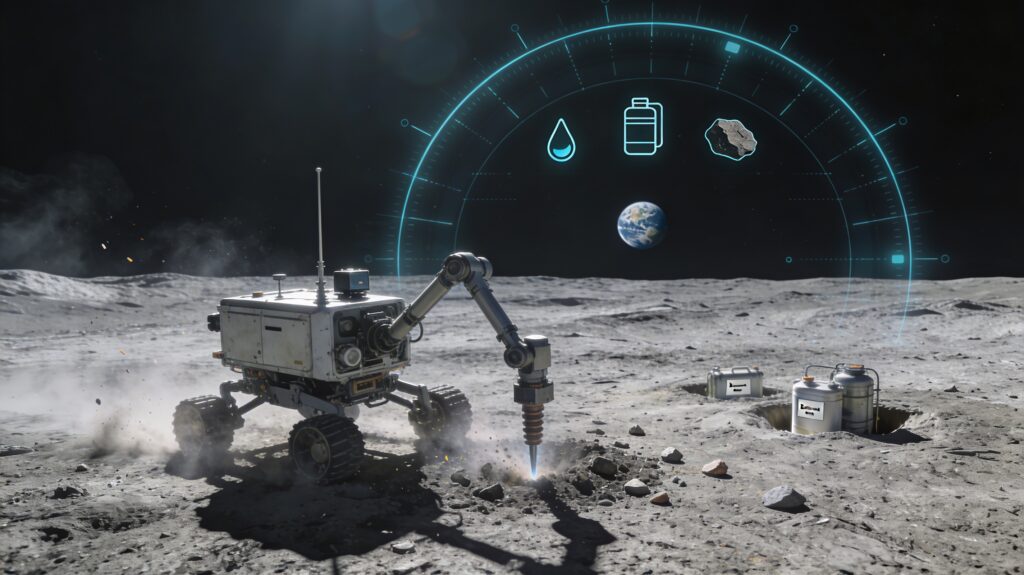
The types of resources targeted by space mining efforts vary widely, depending on the body and the intended use. On the Moon, for instance, the primary targets include water ice, which is critical for life support and as a propellant (breaking down into hydrogen and oxygen), and lunar regolith, which contains elements like silicon, aluminum, iron, and titanium, useful for construction. Helium-3, a rare isotope on Earth but more abundant on the Moon, is often cited as a potential future fuel for nuclear fusion, though this remains highly speculative.
Asteroids are thought to be rich in metals, particularly platinum group metals (PGMs) like platinum, palladium, and rhodium, which are crucial for electronics and catalysts on Earth. Some asteroids are also believed to contain significant amounts of iron, nickel, and cobalt, similar to Earth’s core. Carbonaceous chondrite asteroids, in particular, are considered prime targets for water and other volatiles (compounds with low boiling points), which could be invaluable for in-space applications. These volatiles could be used to create fuel, breathable air, and drinking water for deep-space missions, dramatically reducing the mass that needs to be launched from Earth.
The theoretical process often involves several stages:
- Prospecting and Characterization: Identifying suitable asteroids or lunar regions, mapping their composition and resource concentration.
- Rendezvous and Capture: Reaching the target body and establishing a stable orbit or landing. For smaller asteroids, the concept of “asteroid capture” – bringing an entire small asteroid into Earth orbit – has been explored.
- Extraction: Utilizing various methods depending on the resource. For water ice, this might involve heating the regolith to sublimate the ice, then condensing the vapor. For metals, it could involve crushing rock and using chemical or magnetic separation techniques.
- Processing: Refining the raw materials into usable forms. This is often the most complex step, as it requires compact, autonomous industrial processes capable of operating in extreme environments.
- Transportation: Moving the refined resources to where they are needed, whether that’s an orbital depot, a lunar base, or back to Earth.
While the theory of space mining is compelling, the practical implementation faces daunting challenges that push the boundaries of current engineering and economic models.
How Far the Technology for Space Mining Actually Is
The vision for full-scale space mining is decades away, but foundational technologies are being developed and tested today. It’s important to distinguish between what’s possible in a lab or in low-Earth orbit (LEO) and what’s ready for commercial deployment on the Moon or an asteroid.
Current capabilities largely fall into a few key areas:
- Exploration and Characterization: We have sophisticated robotic probes that can reach and study distant asteroids and the Moon. Missions like NASA’s OSIRIS-REx and JAXA’s Hayabusa2 have successfully collected samples from asteroids (Bennu and Ryugu, respectively) and returned them to Earth. These missions demonstrate our ability to precisely navigate to small celestial bodies, land, collect material, and return. Lunar orbiters and landers have also mapped water ice deposits at the Moon’s poles. This capability is relatively mature, though detailed mapping of resource concentration for specific mining operations is still nascent.
- In-Situ Resource Utilization (ISRU) Experiments: This is perhaps the most direct precursor to space mining. ISRU refers to the practice of “living off the land” by utilizing resources found at the destination. NASA and other agencies are actively researching and demonstrating ISRU technologies. For example, the MOXIE instrument on the Perseverance rover on Mars successfully produced oxygen from the Martian atmosphere, a critical step for future human missions. On the Moon, experiments are planned or underway to demonstrate the extraction of water from lunar regolith and the use of lunar soil for 3D printing structures. These are small-scale, proof-of-concept experiments, not industrial operations.
- Robotics and Automation: Many aspects of space mining will require advanced robotics capable of operating autonomously or semi-autonomously in harsh, remote environments. Earth-based mining operations already use significant automation, but adapting this to vacuum, extreme temperatures, and long communication delays is a major challenge. Technologies for autonomous navigation, manipulation, and repair are under constant development, but robust, self-repairing industrial robots for deep space are still far from reality.
- Launch and In-Space Logistics: While not directly mining technology, the cost and efficiency of getting to space, moving around once there, and returning are critical enablers. Reusable rockets like SpaceX’s Falcon 9 and Starship are dramatically reducing launch costs, making the economics of space endeavors more feasible. However, the cost of sustained operations far from Earth remains incredibly high.
Which parts are closer to practical? The ability to prospect and characterize resources is relatively advanced. We can identify targets and understand their composition. Small-scale ISRU demonstrations are also showing promise in controlled environments. What remains largely experimental and far from practical are the full-scale extraction, processing, and transportation systems needed for economically viable space mining. Developing robust, long-lasting machinery that can operate autonomously for years without human intervention in vacuum, extreme radiation, and temperatures ranging from hundreds of degrees Celsius to near absolute zero is a monumental engineering feat. The processing plants alone, which would need to refine raw regolith into usable materials, are incredibly complex, and designing them to be compact, energy-efficient, and fully autonomous for space is a challenge that has only just begun to be addressed.
How Economics Makes or Breaks Space Mining
The single most formidable barrier to space mining is arguably economics. While the theoretical value of resources in space can be staggering, the cost of acquiring them currently outweighs any potential return by orders of magnitude.
Consider the cost vs. value problem:
- Launch Costs: While decreasing, sending mass into space is still expensive. Getting to the Moon costs thousands of dollars per kilogram, and reaching asteroids further out is even more. A single mining mission would require launching many tons of equipment.
- Operational Costs: Operating machinery millions of miles from Earth involves immense costs for mission control, telemetry, maintenance, and energy. The lifespan of equipment in space is also a major concern; a breakdown could mean the loss of an entire mission.
- Return Transport Costs: If the goal is to bring materials back to Earth, the cost of returning them must be factored in. Bringing a kilogram of platinum from an asteroid back to Earth would likely cost far more than the market value of that platinum today, even at current high prices. The energy required for such a return trip is substantial.
- Processing Costs: The energy and complexity of on-site processing are enormous. Refining raw ore into usable metals requires significant power, chemicals, and sophisticated machinery. Developing autonomous, miniaturized versions of these industrial processes for space is incredibly expensive.
For space mining to become economically viable, several things must happen:
- Drastic Reduction in Launch Costs: Reusable rockets are a step in the right direction, but costs need to fall even further.
- Significant Demand for Off-World Resources: If resources are mined for use in space (e.g., fuel for other spacecraft, construction materials for orbital habitats), the economic equation changes. Transporting materials from the Moon to LEO is far cheaper than bringing them from Earth to LEO.
- High-Value Resources: For materials brought back to Earth, only extremely high-value, rare materials (like PGMs) could potentially justify the cost, and even then, the quantity brought back would need to be carefully managed to avoid crashing market prices.
- Scalability: Initial efforts will be small-scale, but to be profitable, operations would need to scale up to industrial levels, which implies massive upfront investment and robust, self-sustaining infrastructure.
Realistic timeframes and scale for economic viability are long-term. Most experts agree that profitable space mining for Earth markets is at least 30-50 years away, if not more. The initial phases are likely to focus on low-cost, high-impact resources for in-space use, primarily water ice for propellant. Even then, the scale required for a sustainable business model is substantial, demanding hundreds of millions, if not billions, of dollars in investment before any return can be expected. This makes space mining a high-risk, long-term investment that few traditional venture capital firms are equipped to handle.
How Law and Policy Affect Space Mining
The legal and policy landscape for space mining is a complex and evolving frontier, fraught with ambiguities that matter immensely to potential investors, companies, and nation-states. The foundational document for international space law is the 1967 Outer Space Treaty (OST), which states that outer space, including the Moon and other celestial bodies, is “not subject to national appropriation by claim of sovereignty, by means of use or occupation, or by any other means.”
This prohibition on national appropriation is a cornerstone, but it leaves a gaping hole when it comes to resource extraction. If a nation cannot claim sovereignty over a celestial body, can a company claim ownership of resources extracted from it? The OST does not explicitly address resource ownership, leading to different interpretations.
- The “Common Heritage of Mankind” Argument: Some argue that space resources are the “common heritage of mankind,” meaning any profits derived from them should be shared among all nations, or that their use should be regulated by an international body. This view often points to the Moon Agreement of 1979, which explicitly states that the Moon and its resources are the common heritage of mankind and calls for an international regime to govern their exploitation. However, the Moon Agreement has been ratified by very few spacefaring nations (e.g., not by the US, Russia, or China), rendering it largely ineffective in practice.
- National Legislation for Resource Rights: In response to this ambiguity, some nations have taken unilateral action. The United States passed the SPACE Act of 2015, which explicitly grants U.S. citizens the right to “engage in the commercial exploration and recovery of space resources.” Luxembourg, a significant player in the space industry, passed similar legislation in 2017. These laws assert that while no one can own a celestial body, private entities can own the resources they extract from it. This is analogous to international maritime law, where fish in international waters are not owned by any nation, but once caught, they become the property of the fishing vessel.
- Existing Ambiguities and Why They Matter: The key ambiguity is the conflict between the OST’s non-appropriation principle and national laws granting resource ownership. Does extracting resources constitute a form of “appropriation” of a celestial body, in violation of the OST? This question remains unresolved internationally.
- For Investors: Legal certainty is paramount. Without clear, internationally recognized rules, investors face significant regulatory risk. What if an international tribunal later rules that extracted resources are not privately owned? What if another nation disputes the right of a company to mine a particular asteroid?
- For States: The lack of a clear framework could lead to disputes between nations over prime mining locations or resource claims. It also raises questions about environmental protection in space, safety zones around mining operations, and liability for any damage caused.
- For Operations: Practical issues like assigning orbital slots for processing facilities, managing space debris created by mining, and ensuring fair access to resources for all nations are also critical and currently lack a governing structure.
While efforts are underway to develop international norms and principles, such as through the Artemis Accords (led by the US) which include provisions for resource extraction in a non-appropriation context, a universally accepted legal framework for space mining is still years, if not decades, away. This legal vacuum adds another layer of risk and uncertainty to an already challenging endeavor.
How Space Mining Could Support In‑Space Infrastructure First
Perhaps the most realistic and economically plausible pathway for space mining in the near-to-medium term is not to bring valuable materials back to Earth, but to use them in space. This concept is often referred to as “in-space resource utilization” or “space logistics.”
The rationale is straightforward: launching anything from Earth is incredibly expensive due to the energy required to escape Earth’s gravity well. If resources can be sourced from the Moon or asteroids and processed in space, they become significantly cheaper and more accessible for in-space applications.
Consider the following scenarios:
- Propellant Depots: Water ice, found abundantly at the Moon’s poles and in carbonaceous asteroids, can be broken down into hydrogen and oxygen—the components of highly efficient rocket fuel. Imagine a “gas station” in lunar orbit or at a Lagrangian point (gravitationally stable points in space) fueled by lunar water. Spacecraft heading to Mars or beyond could refuel there, drastically reducing the amount of propellant they need to launch from Earth. This would enable larger payloads, more frequent missions, and lower overall mission costs for deep-space exploration.
- Construction Materials for Orbital Habitats and Structures: The Moon and asteroids contain silicates, metals (iron, nickel, aluminum), and other elements that could be used as raw materials for 3D printing or manufacturing in space. Instead of launching every girder and panel for a space station from Earth, future orbital habitats or lunar bases could be constructed largely from locally sourced materials. This would enable the creation of much larger and more robust structures in space, supporting extended human presence.
- Life Support for Deep Space Missions: Water and oxygen are fundamental for human survival. If these can be produced in space, it reduces the mass of consumables that need to be launched from Earth, making long-duration missions to Mars or beyond more feasible and safer.
- Shielding: Lunar regolith or asteroid material could be used as radiation shielding for spacecraft or habitats, protecting astronauts from harmful cosmic radiation. Launching dense shielding material from Earth is prohibitively expensive.
This “in-space first” approach sidesteps many of the economic hurdles associated with returning materials to Earth. The “customer” is another space entity (a government space agency, another commercial space company), and the “market” is the burgeoning space economy itself. The value proposition shifts from Earth-based commodity markets to the cost savings and enablement of new capabilities in space.
While still requiring significant technological development and investment, the economics of supplying in-space infrastructure are far more compelling than bringing platinum back to Earth. It creates a closed-loop system where space resources support space activities, laying the groundwork for a truly self-sustaining space economy.
How to Spot Hype vs Serious Space Mining Efforts
Given the allure and the challenges of space mining, it’s easy to fall prey to sensational claims. For investors and the public, discerning serious, long-term efforts from pure hype is critical. Here’s a checklist to help you evaluate announcements and pitches:
- Technical Milestones, Not Just Vision Statements:
- Hype: Focuses on grand visions of trillion-dollar industries, futuristic concepts, and hypothetical timelines without concrete steps.
- Serious Efforts: Present specific, achievable technical milestones. Have they successfully demonstrated key technologies in a lab? Are they planning or executing small-scale ISRU experiments on Earth or in LEO? Have they returned samples from an asteroid? Look for proof-of-concept demonstrations, not just animated renderings.
- Funding and Partners:
- Hype: Often relies on crowdfunding, speculative private investment from non-traditional sources, or vague promises of future funding. May lack credible, established partners.
- Serious Efforts: Secure funding from reputable sources like government space agencies (e.g., NASA, ESA), established aerospace companies, or well-known venture capital firms with a track record in deep tech. Look for collaborations with universities or research institutions known for relevant expertise. Who is backing them, and do those backers understand the long-term, high-risk nature of space endeavors?
- Realistic Timelines:
- Hype: Promises commercial operations or significant returns within 5-10 years. Underestimates the time and resources needed for R&D, testing, deployment, and scaling.
- Serious Efforts: Acknowledge that space mining is a multi-decade endeavor. Their roadmaps will typically involve incremental steps over 10-20 years before any significant commercial viability, especially for Earth-return scenarios. They will distinguish between near-term ISRU demonstrations and far-future industrial operations.
- Regulatory Engagement:
- Hype: Ignores or downplays the legal and policy challenges, assuming they will sort themselves out.
- Serious Efforts: Actively engage with national and international regulatory bodies. They will discuss how their operations align with existing space law (like the Outer Space Treaty) or how they are contributing to the development of new frameworks (e.g., through participation in initiatives like the Artemis Accords). They will acknowledge the legal ambiguities as a significant risk factor.
- Focus on In-Space Use First:
- Hype: Primarily emphasizes returning vast quantities of valuable metals to Earth, often with unrealistic market impact analyses.
- Serious Efforts: Often prioritize the development of in-space resource utilization (ISRU) for propellant, construction, or life support. They understand that creating an in-space economy is a more plausible first step than disrupting Earth’s commodity markets.
- Transparency and Peer Review:
- Hype: Relies on flashy press releases and marketing materials, with little technical detail available for scrutiny.
- Serious Efforts: Publish their research in peer-reviewed journals, present at scientific and engineering conferences, and are transparent about their methodologies, challenges, and results. They invite critical assessment from the scientific and engineering communities.
By applying this checklist, you can better distinguish between companies selling dreams and those engaged in the painstaking, long-term work required to make space mining a reality.
How to Put Space Mining in Perspective
Space mining, while a concept brimming with potential, is not a near-term certainty. It’s a complex, multi-decadal endeavor that sits at the intersection of cutting-edge technology, formidable economic hurdles, and an evolving legal landscape. The vision of harvesting untold riches from asteroids and the Moon is compelling, but it’s essential to temper that excitement with a dose of realism.
To put space mining in perspective, we must recognize it as a long-term possibility, not a near-term guaranteed source of riches. The initial phases will almost certainly focus on in-space resource utilization—extracting water for propellant and building materials for orbital or lunar infrastructure. This approach sidesteps the immense costs and market disruptions associated with bringing materials back to Earth and instead focuses on enabling a more sustainable and expansive human presence in space.
The technological challenges are immense, requiring innovations in autonomous robotics, advanced processing in extreme environments, and ultra-reliable long-duration systems. The economic equation remains profoundly difficult, demanding unprecedented reductions in launch costs and the gradual development of an in-space market. Furthermore, the legal framework is still nascent, creating uncertainty for investors and operators.
For those tracking the field, the key is to look for concrete, incremental progress: successful ISRU demonstrations, partnerships with established aerospace entities, transparent technical roadmaps, and a clear understanding of the regulatory environment. Be wary of hyperbolic claims of imminent wealth or quick returns.
Ultimately, space mining represents humanity’s long-term ambition to expand beyond Earth, to become a multi-planetary species, and to eventually build a self-sustaining space economy. It’s a journey of exploration and innovation that will unfold over generations, driven by scientific curiosity, technological ingenuity, and a pragmatic understanding of the extraordinary challenges involved. It’s a marathon, not a sprint, and one that demands patience, sustained investment, and a healthy dose of skepticism to navigate the hype.