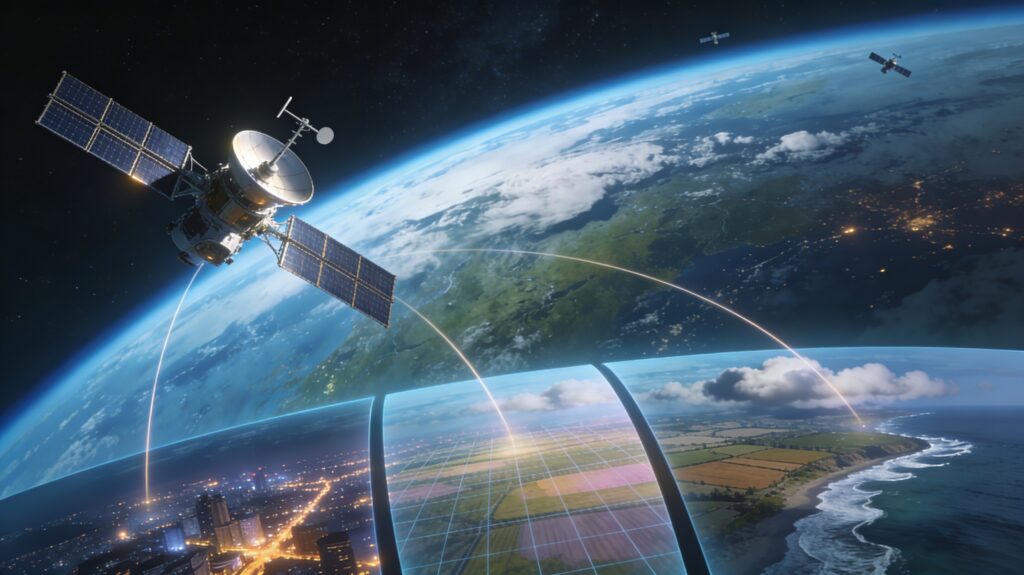
Space economy, once a phrase confined to the pages of science fiction novels and the hushed halls of government agencies, has rapidly transformed into a vibrant, multi-trillion-dollar reality. It’s no longer just about rockets blasting off to distant planets or the dream of lunar colonies; it’s about real businesses, tangible revenue streams, and a rapidly expanding ecosystem touching almost every facet of our daily lives. From the GPS signal guiding your car to the satellite imagery informing agricultural decisions, the infrastructure of space is becoming as indispensable as terrestrial utilities.
For business-minded tech readers, investors, and even curious generalists, the sheer scope and complexity of this burgeoning sector can feel overwhelming. It’s a landscape of cutting-edge technology, geopolitical maneuvering, audacious entrepreneurship, and immense capital investment, all operating in an environment that is, by definition, extraterrestrial. Yet, understanding its core components doesn’t require a degree in astrophysics. It requires a clear, grounded perspective on the forces driving its growth and the tangible services it provides.
This article will break down the intricate world of the space economy into 9 straightforward pieces, offering a clear lens through which to comprehend its current state, its trajectory, and the opportunities and challenges it presents. By the end, you’ll have a much clearer picture of what the space economy truly entails and why it’s one of the most compelling frontiers of the 21st century.
How to Define the Space Economy Today
The space economy can be broadly defined as the sum of all public and private sector activities that create value and benefits for human beings on Earth by exploring, understanding, and utilizing space. This encompasses a vast array of activities, from the manufacturing of satellites and launch vehicles to the provision of satellite-derived services, space tourism, and even future in-space resource utilization. It’s a global, interconnected economic system that relies on both upstream (manufacturing, launch) and downstream (services, data) segments.
Historically, the space economy was almost exclusively government-funded, driven by national security interests and scientific exploration. Think of the Cold War space race or NASA’s Apollo missions. While government spending remains a significant driver, the defining characteristic of the modern space economy is the rapid influx of private capital and entrepreneurial innovation. Billions are being invested by venture capitalists and private equity firms, fueling a new generation of companies that are democratizing access to space and commercializing its applications.
Key segments within this dynamic definition include:
- Upstream: Activities related to manufacturing and launching objects into space. This involves rocket manufacturers, satellite builders, ground segment operators, and launch service providers.
- Downstream: Activities that utilize space assets to provide services and products on Earth. This is the largest and fastest-growing segment, encompassing satellite communications, Earth observation data, navigation services, and a plethora of value-added applications built upon this data.
- Emerging: Newer, often speculative, segments like in-space manufacturing, asteroid mining, space tourism, and orbital debris removal. These areas are nascent but hold significant long-term potential for the space economy.
Understanding this definition is the crucial first step to grasping the immense potential and current realities of the contemporary space economy. It’s a complex interplay of hardware, software, data, and human ingenuity, all aimed at leveraging the unique vantage point and resources of space for terrestrial benefit.
Launch Services – The Foundations of the Space Economy
At the very heart of the space economy lies the ability to get objects into orbit: launch services. Without reliable, affordable access to space, none of the other segments, from satellite communications to Earth observation, would be possible. For decades, space launches were prohibitively expensive, infrequent, and largely the domain of a few national space agencies. This limited innovation and kept the overall space economy relatively small.
However, the past decade has witnessed a revolutionary shift in this fundamental pillar. Companies like SpaceX, Blue Origin, Rocket Lab, and Arianespace have driven down launch costs dramatically through reusability, modular designs, and increased competition. SpaceX’s Falcon 9, with its reusable first stage, has been a game-changer, slashing the cost per kilogram to orbit and increasing launch cadence to unprecedented levels. This innovation has created a virtuous cycle: lower launch costs enable more satellites to be deployed, which in turn drives demand for even more launches.
The impact of falling launch costs cannot be overstated. It has democratized access to space, allowing smaller companies, universities, and even individual researchers to launch their own payloads. This has fueled the explosion of small satellite constellations (smallsats), which are cheaper to build and launch, making new business models viable. For instance, instead of launching one massive, expensive satellite, companies can now deploy dozens or even hundreds of smaller, specialized satellites that work together as a network.
This increased accessibility is critical for the entire space economy. It means:
- More innovation: New ideas and technologies can be tested in orbit without multi-million dollar investments.
- New business models: Companies can build constellations for global internet, real-time Earth imaging, or specialized IoT services.
- Increased resilience: Distributed satellite networks are less vulnerable to single points of failure.
- Faster deployment: Satellites can be replaced or upgraded more frequently, keeping pace with technological advancements.
In essence, launch services are the fundamental transportation network for the space economy. As this network becomes more efficient and affordable, it unlocks exponential growth and innovation across all other sectors, proving that the foundation of the space economy is becoming stronger and more accessible than ever before.
Satellites – Communication, Navigation, and Imaging
Once objects are launched into space, satellites become the primary workhorses of the space economy, providing an incredible array of services that have become integral to modern life. These orbiting platforms are far more diverse than many realize, each designed for specific missions that generate significant economic value. The three main categories that underpin much of the current space economy are communication, navigation, and Earth-observation satellites.
1. Communication Satellites:
These are perhaps the most widely recognized type, forming the backbone of global connectivity. Geostationary satellites, positioned 22,236 miles above the Earth, provide continuous coverage to vast regions, enabling everything from television broadcasting and secure government communications to internet access in remote areas and maritime operations. The emergence of Low Earth Orbit (LEO) constellations, like Starlink and OneWeb, is revolutionizing this sector further. By operating closer to Earth, LEO satellites offer significantly lower latency and higher bandwidth, promising truly global, high-speed internet access even in the most underserved locations. The revenue sources here are direct: subscriptions for internet services, bandwidth leasing for telecommunications companies, and secure communication services for defense and enterprise clients. This segment alone represents a substantial portion of the overall space economy.
2. GPS/GNSS (Global Navigation Satellite Systems):
While often taken for granted, the precise timing and positioning data provided by satellite navigation systems (like the US’s GPS, Russia’s GLONASS, Europe’s Galileo, and China’s BeiDou) are foundational to countless industries. Beyond guiding your car or smartphone, GNSS data is critical for precision agriculture (optimizing planting and harvesting), logistics and supply chain management, financial transaction timing, air traffic control, emergency services, and even seismic monitoring. The economic impact of GNSS is immense, estimated to contribute hundreds of billions annually to the global economy, primarily through the efficiency gains and new services it enables across various sectors. The revenue is often indirect, embedded in devices and services that rely on the free-to-air signals.
3. Earth-Observation Satellites:
These satellites are essentially eyes in the sky, collecting vast amounts of data about our planet. They range from optical satellites that capture high-resolution imagery to radar satellites that can see through clouds and at night, and hyperspectral satellites that detect specific chemical signatures. This data is invaluable for:
- Environmental Monitoring: Tracking climate change, deforestation, water resources, and urban sprawl.
- Disaster Response: Assessing damage from floods, wildfires, and earthquakes, aiding rescue efforts.
- Agriculture: Monitoring crop health, predicting yields, and optimizing irrigation.
- Defense & Intelligence: Surveillance, reconnaissance, and geopolitical monitoring.
- Insurance: Assessing damage claims and verifying conditions.
Revenue in this sector comes from selling raw satellite imagery, providing sophisticated data analytics services built upon that imagery, and offering subscriptions to specialized monitoring platforms. Companies like Planet Labs, Maxar, and Airbus Defence and Space are major players in this segment, transforming raw photons into actionable insights for a diverse range of clients, thereby significantly contributing to the downstream elements of the space economy.
Together, these satellite applications form the bedrock of the modern space economy, providing essential services and generating considerable economic activity, demonstrating how space is not just about exploration, but about delivering tangible, everyday value.
Space-Based Data and Analytics
While satellites gather an astonishing amount of raw data from orbit, the true economic value is often unlocked when that data is processed, analyzed, and transformed into actionable intelligence. This is where the segment of space-based data and analytics comes into its own, representing a rapidly growing and highly lucrative part of the downstream space economy. It’s the bridge between raw satellite signals and real-world business decisions.
Imagine a satellite capturing daily images of thousands of oil storage tanks worldwide. Individually, these images are just pixels. But with sophisticated AI and machine learning algorithms, analysts can track the shadows cast by floating lids on these tanks, accurately estimating global oil inventory levels. This insight is gold for hedge funds, energy traders, and commodity analysts, allowing them to make more informed investment decisions. This is just one example of how satellite data becomes a powerful analytics product.
The applications span a vast array of terrestrial industries:
- Finance and Investment: Beyond oil inventories, satellite data can monitor supply chain activity, track construction progress of major infrastructure projects, assess retail foot traffic (via parking lot analysis), and even predict crop yields, all providing an edge to investors looking for alternative data sources. This provides a distinct competitive advantage in fast-moving markets.
- Agriculture: High-resolution multispectral imagery allows farmers to monitor crop health down to the individual plant level, detect disease outbreaks early, optimize irrigation, and precisely apply fertilizers. This leads to increased yields, reduced waste, and more sustainable farming practices. Precision agriculture, heavily reliant on satellite data, is a major growth area within the space economy.
- Insurance: After a natural disaster like a hurricane or flood, satellite imagery can quickly assess damage over vast areas, accelerating claims processing and enabling more efficient resource deployment. It also helps in risk assessment for underwriting policies by monitoring environmental changes over time.
- Government and Urban Planning: Satellite data assists in urban growth monitoring, infrastructure planning, illegal deforestation detection, border surveillance, and maritime domain awareness (tracking ships). Cities can use it to manage resources, monitor air quality, and plan for future development.
- Logistics and Supply Chain: Tracking global shipping, monitoring port activity, and optimizing delivery routes all benefit from satellite-derived insights, enhancing efficiency and resilience in complex supply chains.
The transformation of raw data into valuable analytics requires significant investment in cloud computing, big data infrastructure, and specialized AI/ML expertise. Companies in this space are not just selling images; they are selling insights, predictions, and decision-support tools. This segment highlights how the space economy isn’t confined to space itself, but permeates and enhances traditional industries on Earth, demonstrating a powerful return on investment for space-based infrastructure. The future growth of the space economy is heavily tied to the continued innovation in turning this deluge of data into actionable intelligence.
Space Tourism and Human Spaceflight
When most people think of the space economy beyond satellites, their minds often jump to space tourism. The allure of seeing Earth from orbit or walking on another celestial body is undeniably powerful. However, it’s crucial to understand where space tourism and broader human spaceflight initiatives realistically stand today: they are early, extremely expensive, and primarily serve a niche ultra-high-net-worth market.
Currently, space tourism exists in two primary forms:
- Suborbital Flights: Companies like Virgin Galactic offer short “up and down” trips that briefly cross the Kármán line (the internationally recognized boundary of space, 100 km above Earth) before returning to land. Passengers experience a few minutes of weightlessness and see the curvature of the Earth against the blackness of space. These flights are still in their infancy, with limited availability and price tags in the hundreds of thousands of dollars.
- Orbital Flights: This is the most exclusive and costly form, currently facilitated by companies like SpaceX (in partnership with NASA) and formerly by the Russian space agency. Individuals pay tens of millions of dollars for multi-day trips to the International Space Station (ISS) or free-flying orbital missions. These are true space missions, requiring extensive training, and are accessible only to a tiny fraction of the global population.
While these ventures capture headlines and public imagination, their contribution to the overall space economy is still relatively small compared to the commercial satellite and data sectors. They represent a long-term investment in a future where space travel might become more common, but they are not yet a significant revenue driver.
Looking ahead, where might space tourism and human spaceflight go?
- Increased Accessibility and Lower Costs: As launch costs continue to fall and reusability improves, the price point for both suborbital and orbital flights will eventually decrease. This will broaden the market, though it will likely remain a luxury experience for the foreseeable future.
- Dedicated Space Stations and Habitats: Concepts like Axiom Space’s commercial space station modules or even future lunar bases could offer more prolonged and diverse experiences for tourists, researchers, and even specialized workers. These would create new demand for transportation, life support systems, and in-space amenities.
- Lunar and Martian Exploration: While not “tourism” in the commercial sense yet, government-led initiatives like NASA’s Artemis program aim to return humans to the Moon and eventually Mars. These programs drive significant investment in advanced propulsion, habitat development, and life support, which could eventually trickle down into commercial applications.
- Space-Based Research and Manufacturing: Beyond tourism, human spaceflight supports microgravity research, in-space assembly, and future manufacturing processes that leverage the unique environment of space. This “industrialization of space” could become a more significant economic driver than pure tourism in the medium term.
The human element of the space economy is undoubtedly captivating. While space tourism is still in its nascent, exclusive phase, it serves as a powerful symbol of ambition and innovation. Its true economic impact lies less in current ticket sales and more in its potential to drive technological advancements that will eventually make space more accessible and commercially viable for a wider range of human activities, expanding the overall footprint of the space economy.
Defense and National Security in the Space Economy
While the commercialization of space often dominates discussions about the space economy, it’s impossible to fully understand the sector without acknowledging the profound and enduring role of defense and national security spending. In many ways, military and intelligence requirements were the original impetus for space exploration and continue to be a massive, foundational component of the global space economy.
Governments worldwide invest heavily in space capabilities for a myriad of reasons, primarily centered on national security:
- Intelligence, Surveillance, and Reconnaissance (ISR): Military satellites provide critical imagery, signals intelligence, and early warning capabilities, allowing nations to monitor adversaries, track troop movements, and detect missile launches. These systems are invaluable for strategic planning and tactical operations.
- Communication: Secure and resilient satellite communication networks are essential for military command and control, enabling forces to communicate globally, often in areas where terrestrial infrastructure is non-existent or compromised.
- Navigation and Timing: GPS and other GNSS systems are not just for civilian use; they are absolutely critical for precision targeting, troop deployment, and synchronized operations across all branches of the military. The integrity and resilience of these systems are paramount for national defense.
- Missile Defense: Early warning satellites detect ballistic missile launches, providing crucial time for defensive measures.
- Space Domain Awareness (SDA): With increasing congestion in orbit, tracking satellites, space debris, and potential threats to space assets has become a critical national security imperative. Investing in SDA capabilities protects multi-billion dollar space infrastructure.
- Counterspace Capabilities: While highly sensitive, nations are also developing capabilities to protect their own space assets and, controversially, to potentially disrupt or deny an adversary’s use of space during a conflict.
The sheer scale of government defense spending on space is enormous. In countries like the United States, a significant portion of the annual space budget is allocated to the Department of Defense (DoD) and intelligence agencies. This spending drives innovation in satellite technology, launch capabilities, ground systems, and cybersecurity, often leading to advancements that eventually find their way into the commercial sector. For example, many technologies developed for military reconnaissance satellites have paved the way for commercial Earth observation platforms.
Furthermore, the geopolitical competition in space is intensifying. Major powers are investing heavily to ensure their access to space and to maintain a strategic advantage. This competition fuels further government investment, creating a robust, if often opaque, segment of the space economy. Companies that secure defense contracts, whether for satellite manufacturing, launch services, or data analytics, often gain a stable revenue stream and validate their technology.
In summary, the defense and national security sector is not just a user of space assets; it is a major economic engine within the space economy, driving research, development, and procurement that underpins much of the industry’s growth and technological advancement. Ignoring this segment would provide an incomplete picture of the overall economic landscape of space.
Emerging Areas: In-Space Manufacturing and Servicing
Beyond the established pillars of launch, satellites, and data, the space economy is constantly pushing the boundaries of innovation into entirely new domains. Two of the most exciting, albeit nascent and speculative, emerging areas are in-space manufacturing and in-space servicing. These concepts promise to fundamentally change how we operate in orbit and beyond, reducing reliance on Earth-bound infrastructure and unlocking new possibilities.
In-Space Servicing:
This segment focuses on extending the lifespan and enhancing the capabilities of existing satellites in orbit. Historically, once a satellite was launched, it was largely a “set it and forget it” proposition. If it ran out of fuel, malfunctioned, or needed an upgrade, it was often decommissioned. In-space servicing aims to change that.
- Repair and Refueling: Companies are developing robotic spacecraft capable of docking with malfunctioning satellites to perform repairs, replace components, or, critically, refuel them. This could dramatically extend the operational life of expensive assets, offering a significant return on investment. Imagine a communications satellite running low on propellant after 15 years; a servicing vehicle could replenish its fuel, allowing it to continue operating for another decade.
- Debris Removal: Space debris is a growing threat to active satellites. In-space servicing technologies could also be adapted for actively deorbiting or capturing defunct satellites and other debris, making space safer for all operators and ensuring the long-term sustainability of the space economy.
- Inspection and Upgrade: Servicing vehicles can provide close-up inspections of satellites, diagnose issues, and even attach new modules or instruments, upgrading capabilities without the need for an entirely new launch.
In-Space Manufacturing:
This ambitious area seeks to build and assemble structures directly in orbit, rather than launching them fully formed from Earth. The advantages are numerous:
- Larger Structures: Freed from the constraints of rocket fairing sizes, massive structures like large telescopes, advanced antennas, or even entire space habitats could be assembled in space.
- Specialized Materials: The microgravity environment allows for the creation of unique materials and components that are impossible or difficult to produce on Earth, such as ultra-pure optical fibers or novel semiconductor materials.
- Resource Utilization: In the longer term, in-space manufacturing could involve using resources harvested from the Moon or asteroids (known as In-Situ Resource Utilization, or ISRU) to build structures or propellant, further reducing reliance on Earth and enabling true deep-space exploration and settlement.
- 3D Printing in Space: Experimentation with 3D printing in microgravity is already underway, demonstrating the potential to produce tools, spare parts, and even complex spacecraft components on demand, reducing logistics and supply chain challenges for long-duration missions.
Timeframes and Uncertainty:
It’s crucial to clarify that while these areas hold immense promise, they are largely experimental and face significant technical, economic, and regulatory hurdles. Most of these capabilities are in the demonstration phase, with full commercial viability still years, if not decades, away. The capital intensity is high, and the return on investment is speculative. However, the potential for these emerging areas to create entirely new markets and fundamentally alter the space economy is undeniable. They represent the cutting edge of innovation, pushing the boundaries of what’s possible and laying the groundwork for a truly industrialized and self-sustaining presence in space.
How to Evaluate Opportunities and Risks in the Space Economy
For investors, entrepreneurs, or simply those looking to understand the practical implications of the space economy, evaluating its opportunities and risks requires a clear, grounded framework. It’s easy to get swept up in the futuristic hype, but a disciplined approach is essential.
Here’s a simple framework to consider:
- Revenue Now vs. Speculative Future:
- “Revenue Now” Opportunities: These are segments with established business models, existing customers, and clear revenue streams. Think of satellite communications providers (like Viasat, SES), Earth observation data companies (Planet Labs, Maxar), and established launch service providers (SpaceX, ULA, Arianespace). These offer more predictable returns but may have lower growth ceilings or face intense competition.
- “Speculative Future” Opportunities: These are the emerging areas like in-space manufacturing, asteroid mining, advanced space tourism, or novel propulsion systems. They promise potentially massive returns but come with high technical risk, long development timelines, uncertain market demand, and significant capital requirements. Investing here is often akin to venture capital, with a portfolio approach needed to mitigate risk.
- Capital Intensity:
The space economy is inherently capital-intensive. Building rockets, satellites, and ground stations requires billions of dollars.- High Capital Intensity: Launch providers, satellite manufacturers, and large constellation operators fall into this category. They require significant upfront investment but can yield substantial returns once operational.
- Lower Capital Intensity: Downstream data analytics companies or software providers that leverage existing space infrastructure can have lower capital requirements. They build value on top of the physical assets, often with higher margins and scalability. This is often where smaller startups can find a foothold.
- Regulation and Geopolitics:
Space is not a free-for-all. It’s heavily regulated by national and international treaties.- Regulatory Hurdles: Launch licenses, spectrum allocation for satellites, orbital debris mitigation, and international agreements all impact business operations. Changes in policy or new regulations can create significant headwinds or open new opportunities.
- Geopolitical Risks: The dual-use nature of many space technologies (civilian and military) means that geopolitical tensions can directly affect the industry. Export controls, sanctions, and national security interests play a major role in market access and technology transfer.
- Competition and Differentiation:
The space economy is attracting immense talent and capital, leading to fierce competition.- Established Players: Large aerospace and defense contractors (Boeing, Lockheed Martin, Airbus) have deep pockets and long-standing government contracts.
- New Space Disruptors: Agility, innovation, and lower cost structures are the hallmarks of companies like SpaceX and Rocket Lab, which are challenging incumbents.
- Differentiation: Success often hinges on a unique technological advantage, a specialized niche, or a superior business model. Simply launching another satellite is rarely enough; the value is in what that satellite enables.
Why Most People Interact Indirectly:
For the average individual or even many investors, direct investment in the most speculative parts of the space economy (e.g., funding a lunar mining startup) is often impractical or too risky. Most people interact with the space economy indirectly, often without realizing it. When you use GPS, make a video call, watch satellite TV, or benefit from weather forecasts, you are a consumer of space-based services. Similarly, many investors will gain exposure through ETFs or mutual funds that include aerospace companies, telecommunications providers, or tech firms leveraging satellite data, rather than through direct investment in early-stage space startups.
Understanding this framework allows for a more nuanced and realistic assessment of the true opportunities and challenges within the diverse and dynamic space economy, helping to separate the hype from the tangible value.
Conclusion: How to Follow the Space Economy Without Getting Lost
The space economy is a complex, rapidly evolving frontier, but by breaking it down into its core components, as we’ve done with these nine pieces, its intricate tapestry begins to make sense. We’ve journeyed from the foundational role of launch services, through the indispensable utility of communication, navigation, and Earth observation satellites, to the transformative power of space-based data analytics. We’ve explored the aspirational yet nascent world of space tourism and human spaceflight, acknowledged the bedrock influence of defense and national security spending, and peered into the future with emerging areas like in-space manufacturing and servicing. Finally, we’ve laid out a framework for evaluating the opportunities and risks inherent in this high-stakes, high-reward sector.
The key takeaway is this: the space economy is no longer a distant dream. It’s a tangible, growing sector that is already delivering immense value to Earth-bound industries and shaping our future. Its impact is felt in global connectivity, precision agriculture, disaster response, financial markets, and national security, often in ways that are invisible to the end-user. The convergence of technological advancements, falling costs, and increasing private investment is creating an unprecedented era of innovation and commercialization in space.
For those eager to keep track of this dynamic landscape without getting lost in the technical jargon or futuristic speculation, here are a few straightforward ways to stay informed:
- Subscribe to Reputable Space Industry Newsletters and Publications: Outlets like SpaceNews, Ars Technica’s space section, Payload Space, or The Space Review offer regular updates, in-depth analysis, and reporting on commercial, government, and scientific developments. These sources cut through the noise and provide grounded reporting.
- Monitor Major Launch Manifests and Mission Updates: Keep an eye on announcements from key launch providers like SpaceX, ULA, Arianespace, and Rocket Lab. Successful launches and new satellite deployments are tangible indicators of growth and progress in the space economy. Pay attention to what is being launched and who is launching it.
- Track Key Regulatory and Policy Developments: Space is a global domain, and policy shifts—whether related to spectrum allocation, orbital debris, national space strategies, or international cooperation—can have profound impacts. Following the actions of space agencies (NASA, ESA, JAXA) and national governments can provide insights into future trends and potential market changes.
- Follow Industry Leaders and Innovators on Professional Platforms: Many CEOs, founders, and engineers in the “New Space” sector are active on platforms like LinkedIn or X (formerly Twitter). Their insights can offer a direct window into the challenges and triumphs shaping the industry.
By focusing on these practical avenues, you can navigate the exciting and complex world of the space economy, understanding its current trajectory and appreciating its profound implications for our collective future. The journey into space is accelerating, and staying informed is the best way to be a part of it.