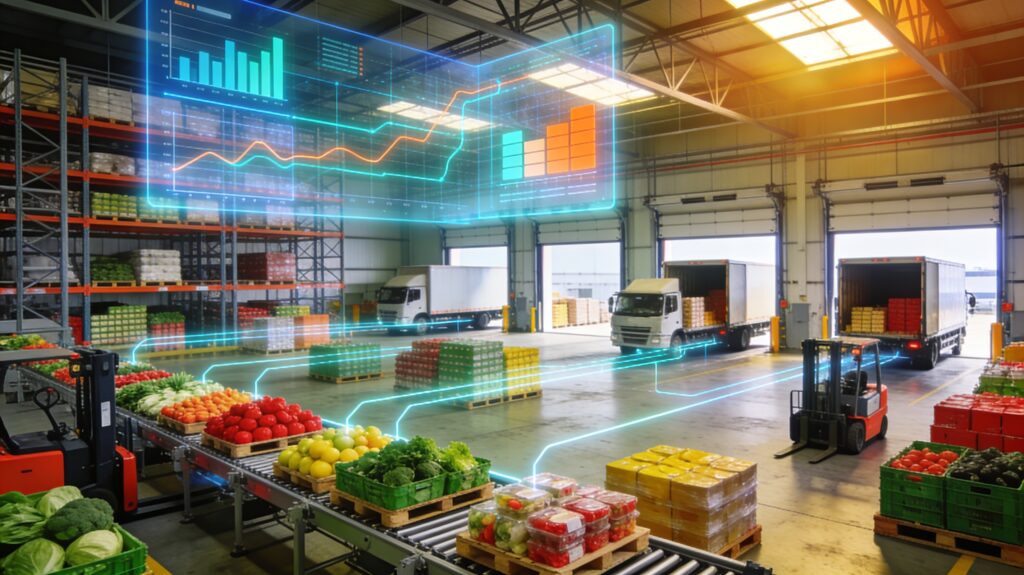
AI in grocery supply chain represents a transformative opportunity for an industry that operates on notoriously thin margins. Grocers face a constant battle against waste, from spoilage and expired products to inefficient logistics and misaligned inventory. This waste doesn’t just erode profits; it impacts sustainability goals, customer satisfaction through stockouts, and the overall operational efficiency of a complex network.
The grocery supply chain is a delicate ecosystem where every decision, from initial procurement to final shelf placement, carries financial implications. In an environment where a 1% improvement in efficiency can translate into millions, the potential for artificial intelligence to drive significant change is immense. This article will show you exactly how to use AI in grocery supply chain operations to cut waste dramatically, improve product availability, and ultimately boost the bottom line. We’ll explore practical applications, from predicting demand with unprecedented accuracy to optimizing delivery routes and implementing dynamic pricing strategies, providing concrete examples and actionable insights for grocery retailers, supply-chain managers, and CPG operators alike.
How the Grocery Supply Chain Works in Simple Steps
To understand where AI can make an impact, it’s crucial to first grasp the fundamental flow of the grocery supply chain. While seemingly straightforward, it’s a highly intricate network designed to move thousands of diverse products, many with short shelf lives, from various origins to millions of consumers daily. The journey typically unfolds in these high-level steps:
- Producers/Manufacturers: This is where raw ingredients are harvested, processed, or manufactured into finished goods. This includes farms for fresh produce, dairies for milk, bakeries for bread, and factories for packaged items. Producers often deal with seasonality, weather dependency, and fluctuating yields, introducing initial variability.
- Distribution Centers (DCs): Products consolidate from multiple producers at regional or national distribution centers. Here, goods are received, sorted, stored, and then prepared for shipment to individual stores or direct-to-consumer channels. DCs act as critical buffers, managing inventory and facilitating efficient transportation.
- Transportation and Logistics: This phase involves moving products from producers to DCs, and then from DCs to retail stores or last-mile delivery hubs. This can involve a mix of trucks, trains, ships, and even air freight, all requiring careful planning to optimize routes, minimize transit times, and control costs, especially for temperature-sensitive items.
- Retail Stores or Delivery Hubs: Products arrive at brick-and-mortar grocery stores, dark stores, or micro-fulfillment centers. Here, they are unpacked, stocked on shelves, or prepared for online order fulfillment and last-mile delivery. Store-level inventory management and merchandising become paramount.
- Customers: The final step involves customers purchasing products either in-store or through e-commerce channels for home delivery or pickup. Customer demand directly influences the entire upstream process.
Within this flow, uncertainty and waste typically appear at several critical junctures:
- Demand Variability: Predicting precisely what customers will buy, when, and in what quantity is exceedingly difficult. Unexpected weather, local events, promotions, or even social media trends can cause sudden spikes or drops in demand.
- Inventory Imbalances: Inaccurate demand forecasts lead to either overstocking (resulting in spoilage, markdowns, and storage costs) or understocking (leading to lost sales, frustrated customers, and potential brand damage). Perishable items like fresh produce, meat, and dairy are particularly vulnerable.
- Logistical Inefficiencies: Suboptimal routing, partially filled trucks, missed delivery windows, or excessive transit times can lead to higher fuel costs, increased labor expenses, and accelerated spoilage, especially for temperature-controlled goods.
- Shelf Life Management: For products with short expiry dates, managing inventory effectively to sell before spoilage is a constant challenge. This is where a significant portion of food waste occurs.
- Pricing and Promotions: Setting the right price at the right time to clear inventory without sacrificing margins or customer perception is complex. Misjudged promotions can either fail to move product or unnecessarily cannibalize full-price sales.
This is precisely where the power of AI in grocery supply chain management comes into play. By leveraging advanced analytics and machine learning, AI can address these uncertainties, transforming reactive operations into proactive, data-driven strategies that significantly reduce waste and enhance profitability.
How to Use AI for Demand Forecasting in Grocery
Demand forecasting is the bedrock of an efficient grocery supply chain. Traditionally, grocers have relied on historical sales data, often using simple averages or seasonal adjustments. While this provides a baseline, it struggles to account for the myriad of dynamic factors that influence consumer behavior. This is where AI-based demand forecasting offers a revolutionary leap forward.
AI-based demand forecasting moves beyond simple historical averages by leveraging machine learning algorithms to analyze vast datasets and identify complex, non-obvious patterns. Instead of just looking at past sales of a specific item, AI models can incorporate:
- Granular Sales Data: Not just total sales, but sales by store, by day of the week, by time of day, and even by specific promotions.
- External Factors: Weather patterns (e.g., predicting demand for BBQ items before a sunny weekend), local events (concerts, festivals, school holidays), economic indicators, public health trends, and even competitor activities.
- Promotional Effectiveness: Analyzing the impact of past promotions, discounts, and marketing campaigns to predict their future influence on demand.
- Product Attributes: Understanding how factors like organic certification, brand reputation, or packaging size affect specific product demand.
- Customer Behavior Data: Loyalty program data, online browsing history, and purchase patterns can provide insights into individual or segment-specific preferences.
- Supply Chain Constraints: Incorporating lead times, supplier reliability, and production capacities into the forecast.
How AI Improves Forecasts and Reduces Waste/Stockouts:
- Increased Accuracy and Granularity: AI can generate highly accurate forecasts at a much more granular level—down to individual SKUs, specific stores, and even hourly predictions for critical items. This precision allows grocers to order exactly what’s needed, minimizing excess inventory.
- Example: For fresh produce or bakery items, AI can predict demand for specific varieties at each store, hour-by-hour, allowing bakeries to optimize production batches and stores to adjust display quantities throughout the day, drastically cutting spoilage.
- Proactive Anomaly Detection: AI models are adept at identifying unusual patterns. If a sudden surge in demand for bottled water is detected due to an impending heatwave, the system can flag it, allowing managers to proactively increase orders rather than reacting after shelves are empty.
- Reduced Overstocking: With more accurate forecasts, the risk of ordering too much product decreases significantly. This directly translates to less food waste from expired or spoiled goods, reduced storage costs (especially for refrigerated items), and fewer resources tied up in slow-moving inventory.
- Minimized Stockouts: Conversely, precise forecasts ensure that popular items are consistently in stock. This prevents lost sales, improves customer satisfaction, and maintains brand loyalty. For instance, if an AI model predicts a spike in demand for a particular organic yogurt due to a viral recipe, stores can ensure adequate stock, preventing customer disappointment.
- Optimized Promotional Planning: AI can simulate the impact of different promotional strategies, helping grocers predict which discounts or bundles will effectively move product without over-discounting or creating artificial demand that cannot be met. This ensures promotions are both profitable and efficient in clearing inventory.
By providing a clearer, more dynamic picture of future demand, AI empowers grocers to make smarter purchasing, production, and allocation decisions, fundamentally transforming the initial stages of the supply chain and setting the stage for significant waste reduction.
How to Use AI for Inventory and Replenishment Decisions
Building on accurate demand forecasts, AI truly shines in optimizing inventory levels and automating replenishment decisions. This is where the theoretical predictions are translated into practical actions that directly impact waste and availability.
Traditional inventory management often relies on static reorder points, economic order quantity (EOQ) models, and fixed safety stock levels. While these methods provide a baseline, they struggle with the dynamic nature of grocery retail, especially for perishable goods. AI-driven systems, conversely, offer a far more adaptive and intelligent approach.
Key AI-Driven Inventory and Replenishment Strategies:
- Dynamic Reorder Points and Quantities: Instead of fixed thresholds, AI continuously adjusts reorder points and order quantities based on real-time data. It considers:
- Updated Demand Forecasts: As forecasts become more refined closer to the actual demand period, AI modifies replenishment suggestions.
- Supplier Lead Times and Reliability: If a supplier’s lead time fluctuates, AI can adjust orders to compensate, preventing stockouts or excess.
- Current Inventory Levels: Real-time stock counts, including items in transit, are fed into the system.
- Promotional Calendars: AI ensures sufficient stock for upcoming promotions without over-ordering for post-promotion periods.
- Minimum Order Quantities (MOQs): AI optimizes orders to meet MOQs while minimizing excess.
- Shelf Life Modeling and First-In, First-Out (FIFO) Optimization: For perishable items, AI can go beyond simple FIFO. It can model the remaining shelf life of each batch of product in the warehouse or on the shelf.
- Predictive Spoilage: AI can predict which items are most likely to expire before being sold, based on their remaining shelf life and current demand trends. This enables proactive measures.
- Optimized Picking and Dispatch: In distribution centers, AI can guide picking strategies to prioritize products with shorter remaining shelf lives for dispatch to stores with higher predicted demand for those specific items, or to stores that consistently sell through faster.
- Store-Level Rotation Guidance: At the store level, handheld devices or smart shelf systems can use AI to guide staff on which specific items (e.g., from which delivery batch) should be moved to the front or marked down first.
- Adaptive Safety Stock Optimization: Safety stock is a buffer against unforeseen demand spikes or supply disruptions. Traditional methods often use a blanket approach, leading to unnecessarily high safety stock for some items and insufficient for others. AI optimizes safety stock by:
- Analyzing Demand Volatility: Items with highly fluctuating demand will have higher calculated safety stock, while stable demand items will have lower.
- Assessing Supply Chain Reliability: If a supplier is historically unreliable, AI can recommend higher safety stock for their products.
- Cost-Benefit Analysis: AI weighs the cost of holding safety stock (storage, potential spoilage) against the cost of a stockout (lost sales, customer dissatisfaction) to find an optimal balance.
Concrete Example: Perishable Items with Variable Demand (e.g., Fresh Berries)
Consider a grocery chain selling fresh strawberries. Their demand is highly variable, influenced by seasonality, weather, promotions, and even local events. They also have a very short shelf life (e.g., 5-7 days from harvest).
- Without AI: The store might order a fixed quantity each week based on last year’s sales, plus a general safety buffer. A sudden sunny weekend might lead to stockouts, while a rainy week could result in significant spoilage. Store staff might manually check expiry dates, leading to inefficiencies and missed opportunities for early markdowns.
- With AI:
- Forecast Refinement: AI analyzes current weather forecasts, local event calendars, ongoing promotions for related items (e.g., whipped cream), and real-time sales data from all stores. It predicts demand for strawberries at each individual store, broken down by day.
- Dynamic Replenishment: Based on these granular forecasts, AI calculates the optimal order quantity for each store, dynamically adjusting for the remaining shelf life of current stock and the lead time from the supplier. It might suggest a larger order for a store near a park expecting a sunny weekend and a smaller order for another store.
- Shelf Life Prioritization: In the distribution center, AI identifies pallets of strawberries with the shortest remaining shelf life and prioritizes their dispatch to stores with the highest projected demand, or to stores that have historically high sell-through rates for fresh produce.
- Adaptive Safety Stock: AI recognizes the high demand volatility for strawberries and recommends a slightly higher, but precisely calculated, safety stock for this item compared to, say, canned goods, balancing the risk of stockouts against spoilage.
- In-Store Guidance: As strawberries near their predicted expiry date, the AI system can automatically flag them for potential markdowns, prompting store staff to adjust pricing or move them to a “quick sale” section, minimizing waste.
By integrating demand forecasting with intelligent inventory and replenishment, AI in grocery supply chain operations transforms a reactive, manual process into a proactive, optimized system, significantly reducing waste and ensuring fresh products are consistently available to customers.
How to Use AI in Routing and Logistics for Groceries
The physical movement of goods is a major cost center and a significant source of potential waste in the grocery supply chain. Inefficient routing, suboptimal scheduling, and poorly loaded vehicles contribute to higher fuel consumption, increased labor costs, longer transit times, and crucially, greater spoilage of perishable items. AI and advanced optimization models are revolutionizing this critical area.
How AI and Optimization Models Improve Routing, Scheduling, and Loading:
- Dynamic Route Optimization:
- Beyond Static Routes: Traditional routing often relies on fixed routes or basic GPS. AI-powered systems, however, continuously analyze real-time data to create the most efficient routes.
- Real-time Traffic and Weather: AI integrates live traffic conditions, accident reports, and weather forecasts to dynamically adjust routes, avoiding delays and ensuring timely deliveries. This is critical for fresh produce and frozen goods where even minor delays can impact quality.
- Multi-Stop Optimization: For routes with multiple delivery points (e.g., a truck delivering to several stores), AI calculates the optimal sequence of stops, minimizing total distance traveled and fuel consumed.
- Vehicle Capacity Constraints: AI considers the specific capacity (volume, weight, temperature zones) of each truck and plans routes that maximize utilization while adhering to all constraints.
- Intelligent Scheduling:
- Delivery Window Compliance: Grocers often have tight delivery windows for stores to minimize disruption. AI schedules deliveries to meet these windows while optimizing the overall fleet.
- Driver Availability and Regulations: AI considers driver work hours, breaks, and regulatory compliance (e.g., hours of service) when creating schedules.
- Backhauling Optimization: AI identifies opportunities for “backhauling,” where a truck picks up goods from a supplier or another facility on its return journey, rather than traveling empty. This reduces empty miles and carbon footprint.
- Optimized Loading (Palletization and Cube Utilization):
- Smart Palletization: AI can determine the optimal way to load diverse products onto pallets and then into trucks. This isn’t just about fitting everything; it’s about strategic placement.
- Weight Distribution: AI ensures even weight distribution within the vehicle for safety and fuel efficiency.
- Temperature Zone Management: For mixed loads (e.g., frozen, refrigerated, dry goods), AI ensures items requiring specific temperatures are placed in the correct zones within a multi-compartment truck.
- Delivery Sequence Loading: Products destined for the last stop on a route are loaded first, while items for the first stop are loaded last, ensuring easy access and faster unloading at each destination. This minimizes time spent at each stop, improving overall route efficiency.
Impact on Spoilage and Energy Use:
- Reduced Spoilage:
- Faster Transit Times: Optimized routes and schedules mean products spend less time in transit, especially crucial for highly perishable items. This directly extends their effective shelf life upon arrival at the store.
- Consistent Temperature Control: By optimizing loading and minimizing delays, AI ensures that temperature-sensitive goods maintain their required conditions throughout the journey, preventing premature spoilage.
- Fewer Damages: Better loading practices, including proper bracing and weight distribution, reduce the risk of product damage during transit.
- Lower Energy Consumption and Emissions:
- Minimized Miles Driven: The most direct impact of route optimization is fewer miles traveled by the fleet, leading to significant reductions in fuel consumption.
- Reduced Idling: Efficient scheduling and faster unloading times mean less time spent with trucks idling, further saving fuel and reducing emissions.
- Optimized Vehicle Utilization: Maximizing the load capacity of each truck reduces the number of trips required, contributing to overall energy efficiency.
By intelligently orchestrating the movement of goods, AI in grocery supply chain logistics transforms transportation from a necessary cost into a strategic advantage, directly contributing to both profitability and sustainability goals by drastically cutting waste and energy use.
How to Use AI for Dynamic Pricing and Markdowns
Even with the most accurate forecasts and efficient logistics, some products will inevitably approach their expiry dates or become slow-moving. Traditional markdown strategies often involve fixed percentage discounts at predetermined intervals, which can be inefficient—either too aggressive (eroding margins) or too late (resulting in waste). AI introduces a sophisticated, data-driven approach to dynamic pricing and markdowns, optimizing both waste reduction and profitability.
AI-Driven Dynamic Pricing Strategies Near Expiry:
AI models can analyze a multitude of factors in real-time to recommend the optimal price for a product, especially as it nears its expiry date or as demand patterns shift. This isn’t just about slashing prices; it’s about finding the “sweet spot” that moves inventory efficiently while protecting margins and brand perception.
- Predicting Demand Response to Price Changes:
- Elasticity Modeling: AI learns the price elasticity of demand for different products, categories, and customer segments. It can predict how a 10% discount on a particular brand of yogurt will impact sales volume versus a 20% discount.
- Competitor Pricing: AI monitors competitor pricing for similar products, ensuring markdowns are competitive but not excessively so.
- Historical Markdown Performance: The system analyzes past markdown effectiveness, learning which discounts worked best for which products under what conditions.
- Considering Product Attributes and Context:
- Remaining Shelf Life: This is a primary driver. AI automatically flags products nearing expiry (e.g., 2 days left for fresh meat, 1 day for bakery items) and initiates markdown recommendations.
- Current Inventory Levels: If a store has an unusually high stock of a particular item nearing expiry, AI will recommend a more aggressive markdown.
- Store-Specific Demand: A product might have high demand in one store but low in another. AI tailors markdown advice to individual store contexts.
- Time of Day/Week: AI can suggest specific markdown timings (e.g., a deeper discount on rotisserie chickens in the evening when demand for dinner items is high).
- Complementary Item Sales: AI can identify if a markdown on one item might boost sales of a complementary item (e.g., discounted ground beef leading to increased bun sales).
- Segmented Customer Response:
- Loyalty Program Data: For loyalty members, AI can personalize markdown offers based on their past purchasing behavior and price sensitivity, maximizing the chance of a sale without over-discounting.
How This Reduces Waste While Protecting Brand Perception:
- Maximized Sales Before Expiry: By dynamically adjusting prices, AI ensures that products are sold before they spoil, significantly reducing food waste. Instead of a fixed 50% markdown on the last day, AI might suggest a 20% markdown two days out, then 35% on the last day, adjusting based on real-time sales velocity.
- Optimized Profit Recovery: AI aims to recover the maximum possible value from products that would otherwise go to waste. It avoids unnecessary deep discounts if a smaller price reduction is sufficient to clear inventory.
- Reduced “Fire Sale” Perception: By implementing gradual, data-driven markdowns, grocers can avoid the perception of constant “fire sales” which can devalue their brand. The markdowns are strategic, appearing as smart deals rather than desperate attempts to clear expiring stock.
- Improved Customer Satisfaction: Customers appreciate finding good deals on quality products. AI-driven markdowns can present these opportunities more consistently and relevantly, enhancing the shopping experience.
- Informed Donation Programs: For items that still don’t sell despite markdowns, AI can identify them earlier, facilitating timely donation to food banks rather than outright disposal, further reducing waste and enhancing corporate social responsibility.
By leveraging AI for dynamic pricing and markdowns, grocers can turn potential waste into recovered revenue, striking a delicate balance between profitability, waste reduction, and maintaining a positive brand image. This application of AI in grocery supply chain management is a powerful tool for sustainability and financial health.
How to Start a Practical AI in Grocery Supply Chain Pilot
Implementing AI across an entire, complex grocery supply chain can seem daunting. A practical, phased approach starting with a pilot program is often the most effective way to demonstrate value, build internal expertise, and gain stakeholder buy-in. Here’s a step-by-step guide to initiating an AI pilot in your grocery supply chain.
- Identify One Category or Region:
- Start Small and Focused: Don’t try to implement AI across all 50,000 SKUs or all 500 stores at once.
- Product Category: Choose a category that is either high-value, high-waste (e.g., fresh produce, bakery, deli, meat), or has particularly volatile demand. Perishables are often excellent candidates due to their direct link to waste.
- Geographic Region/Specific Stores: Alternatively, select a small cluster of stores or a single distribution center and the stores it serves. This limits the scope and makes data collection and impact measurement more manageable.
- Criteria for Selection: Look for areas with clear pain points, accessible data, and a manageable number of variables.
- Choose One Use Case:
- Focus on a Single Problem: Resist the urge to solve everything at once. Pick one specific application of AI that aligns with your chosen category/region and offers clear, measurable benefits.
- Examples:
- Demand Forecasting: Focus on improving forecast accuracy for your selected perishable category at the store level.
- Dynamic Markdowns: Implement AI for pricing adjustments on expiring items within your chosen category.
- Replenishment Optimization: Use AI to optimize order quantities and safety stock for a specific group of SKUs.
- Routing Optimization: Pilot AI for last-mile delivery route optimization for a small fleet serving a specific urban area.
- Clear Objectives: Define what success looks like for this single use case. For example, “Reduce spoilage of fresh berries by 15% in pilot stores.”
- Set Clear, Measurable Metrics:
- Baseline Measurement: Before implementing AI, accurately measure your current performance for the chosen metrics in your pilot area. This baseline is crucial for demonstrating the AI’s impact.
- Key Performance Indicators (KPIs):
- Waste Reduction: Quantify waste by weight, volume, or cost (e.g., percentage of spoilage, value of expired goods). This is often the primary driver for AI in grocery.
- Out-of-Stocks (OOS): Measure OOS rates for key items in the pilot category. Improved availability directly impacts sales and customer satisfaction.
- Margin Improvement: Track gross margin for the pilot category, considering both reduced waste and optimized pricing.
- Inventory Turn: How quickly is inventory moving? AI should improve this.
- Labor Efficiency: For routing, measure driver hours, fuel consumption, and delivery times.
- Customer Satisfaction: Indirectly, reduced OOS and fresher products contribute to higher customer satisfaction scores.
- Regular Monitoring: Establish a system for continuous monitoring of these metrics throughout the pilot.
- Emphasize Cross-Functional Alignment (Merchandising, Operations, Finance, IT):
- Break Down Silos: AI initiatives are rarely successful in isolation. They require strong collaboration across departments.
- Merchandising: Needs to understand how AI-driven forecasts and markdown suggestions will impact product assortment, promotional planning, and category profitability. Their input on product strategies is vital.
- Operations (Supply Chain & Store Ops): Directly impacts how AI recommendations are implemented. They need to understand the new processes, provide feedback on practical challenges, and ensure staff training.
- Finance: Essential for tracking ROI, allocating budget, and understanding the financial impact of waste reduction and margin improvements.
- IT: Critical for data infrastructure, system integration, model deployment, and ongoing technical support. They ensure data quality and system reliability.
- Leadership Sponsorship: Secure buy-in from senior leadership to champion the initiative and resolve potential inter-departmental conflicts.
- Communication: Foster open and continuous communication channels between all involved teams. Regular meetings, clear reporting, and shared understanding of goals are paramount.
By following these steps, a grocery retailer can launch a targeted, manageable AI pilot program that provides tangible results, builds confidence, and lays the groundwork for a broader, more impactful adoption of AI in grocery supply chain management.
Limits and Risks of AI in Grocery Supply Chains
While the potential of AI in the grocery supply chain is immense, it’s crucial to approach implementation with a clear understanding of its limitations and inherent risks. Ignoring these can lead to flawed decisions, operational disruptions, and a loss of trust in the technology.
- Data Quality and Availability:
- “Garbage In, Garbage Out”: AI models are only as good as the data they’re trained on. Inaccurate, incomplete, inconsistent, or biased historical data will lead to flawed forecasts and suboptimal decisions. Common issues include missing sales records, incorrect inventory counts, or inconsistent product categorizations.
- Data Silos: Many grocery organizations have data fragmented across disparate systems (POS, ERP, WMS, CRM), making it challenging to consolidate and clean for AI consumption.
- Cold Start Problem: For new products or stores, there might not be enough historical data to train effective AI models, requiring alternative strategies or initial manual oversight.
- Model Overfitting and Generalization:
- Overfitting: An AI model can become too specialized in the training data, learning noise and specific historical anomalies rather than generalizable patterns. When exposed to new, real-world data, it performs poorly. This is particularly risky in dynamic environments like grocery.
- Lack of Generalization: A model trained on data from one region or store type might not perform well when applied to another with different demographics, shopping habits, or competitive landscapes.
- Black Swan Events: AI models struggle with truly unprecedented events (e.g., a global pandemic, a sudden major economic crisis) that fall outside their training data.
- Opaque Decisions (“Black Box” Problem):
- Lack of Explainability: Many advanced AI models (especially deep learning) are “black boxes.” They provide a recommendation (e.g., “order 350 units,” “markdown by 15%”), but it can be difficult for humans to understand why that specific decision was made.
- Trust and Adoption: If managers and staff don’t understand the rationale behind AI suggestions, they may distrust the system, override its recommendations, or fail to adopt it effectively. This can hinder buy-in and prevent the realization of benefits.
- Auditing and Compliance: In regulated industries, the inability to explain a decision can pose challenges for auditing and compliance.
- Ignoring In-Store Realities and Human Intuition:
- Operational Nuances: AI models might not fully capture the nuances of human behavior or specific in-store operational realities (e.g., a particularly diligent store manager, a local community event not captured in data, a sudden equipment breakdown).
- Loss of Human Expertise: Over-reliance on AI without human oversight can lead to a deskilling of staff and a loss of valuable institutional knowledge and intuition. Experienced store managers often have a “gut feeling” that, while not data-driven, can sometimes be surprisingly accurate.
- Systemic Biases: If historical data contains biases (e.g., consistently understocked certain neighborhoods), AI can perpetuate and even amplify these biases if not carefully monitored.
Encourage Continuous Monitoring and Human Review:
To mitigate these risks, a hybrid approach is essential:
- Human-in-the-Loop: AI should augment, not fully replace, human decision-making. Managers should review AI recommendations, especially during the initial pilot phases, and have the ability to override or adjust them based on their unique insights.
- Performance Monitoring: Continuously track the AI’s performance against key metrics and compare it to traditional methods. Be prepared to identify when models start to drift or perform poorly.
- Feedback Loops: Establish mechanisms for store staff and supply chain operators to provide feedback on AI recommendations. This qualitative data is invaluable for model refinement.
- Explainable AI (XAI): Invest in AI solutions that offer some level of explainability, providing insights into the factors influencing a decision.
- Data Governance: Implement robust data governance practices to ensure data quality, consistency, and security.
- Regular Model Retraining: AI models need to be regularly retrained with fresh data to adapt to changing market conditions and prevent model decay.
By acknowledging these limitations and actively implementing safeguards, grocery retailers can harness the power of AI in grocery supply chain management responsibly, building resilient and intelligent operations that truly deliver on the promise of waste reduction and improved profitability.
How to Scale AI in the Grocery Supply Chain Responsibly
After a successful pilot program, the next challenge is scaling AI responsibly across the broader grocery supply chain. This requires a strategic approach that leverages pilot learnings, addresses organizational complexities, and maintains continuous oversight.
Recap Benefits and Caveats:
Before scaling, it’s vital to clearly articulate the proven benefits and understood limitations from the pilot:
- Benefits: Reiterate the quantifiable successes—e.g., “Our pilot reduced fresh produce waste by 18% and improved on-shelf availability by 10% for key items.” Emphasize the tangible impact on profit margins, sustainability, and customer satisfaction.
- Caveats: Be transparent about the challenges encountered—e.g., “We learned that data quality for legacy product codes was a significant hurdle,” or “Initial user adoption required more intensive training than anticipated.” This honesty builds trust and helps set realistic expectations for the broader rollout.
Suggest a Path from Pilot to Broader Rollout:
Scaling AI is not a “big bang” event; it’s a phased expansion built on a solid foundation.
- Refine and Standardize Processes:
- Document Learnings: Thoroughly document the successful processes, best practices, and lessons learned from the pilot.
- Operational Playbooks: Create clear operational playbooks for how AI recommendations are integrated into daily workflows (e.g., “How to review AI-generated replenishment orders,” “Steps for implementing dynamic markdowns”).
- Data Governance: Formalize data collection, cleaning, and integration processes. Standardize data definitions across the organization.
- Phased Expansion (Geographic or Category-Based):
- Incremental Rollout: Instead of a full enterprise-wide deployment, expand incrementally.
- Geographic Expansion: Roll out to additional clusters of stores, regions, or distribution centers.
- Category Expansion: Apply AI to new product categories, starting with those that share similar characteristics or data structures to the pilot.
- Learn and Adapt: Each phase of expansion should be treated as a mini-pilot, with ongoing monitoring and opportunities for refinement before moving to the next.
- Incremental Rollout: Instead of a full enterprise-wide deployment, expand incrementally.
- Invest in Infrastructure and Integration:
- Scalable Architecture: Ensure the underlying data infrastructure and AI platforms can handle increased data volumes and computational demands as you scale. This might involve cloud-based solutions.
- System Integration: Seamlessly integrate AI tools with existing enterprise systems (ERP, WMS, POS). Manual data transfer or siloed AI tools will hinder scalability.
- API-First Approach: Design for integration using APIs to allow different systems to communicate effectively.
- Comprehensive Training and Change Management:
- Tailored Training Programs: Develop robust training programs for all affected employees—from store associates to supply chain planners and senior management. Training should be role-specific and practical.
- User Adoption Strategy: Address potential resistance to change proactively. Highlight how AI makes jobs easier or more impactful, rather than threatening.
- Communication Strategy: Maintain continuous communication about the why, what, and how of AI implementation, celebrating successes and addressing concerns.
- Build Internal AI Capabilities and Expertise:
- Data Science Teams: Invest in internal data science, machine learning engineering, and data analytics teams to develop, maintain, and continuously improve AI models.
- Cross-Functional AI Champions: Identify and empower “AI champions” within different departments who can advocate for the technology and help bridge the gap between technical teams and operational users.
- Continuous Learning: The AI landscape evolves rapidly. Foster a culture of continuous learning and experimentation within the organization.
- Establish Robust Governance and Ethical Frameworks:
- Monitoring and Auditing: Implement continuous monitoring of AI model performance, ensuring it remains accurate and doesn’t introduce biases. Establish clear audit trails for AI-driven decisions.
- Ethical Guidelines: Develop internal ethical guidelines for AI use, particularly concerning data privacy, fairness, and transparency.
- Security: Ensure robust cybersecurity measures are in place to protect sensitive data used by AI systems.
By embracing a thoughtful, incremental, and people-centric approach to scaling, grocery retailers can successfully integrate AI in grocery supply chain operations, moving from isolated pilot successes to a comprehensive, intelligent, and waste-reducing ecosystem that drives sustained profitability and enhances customer value.
