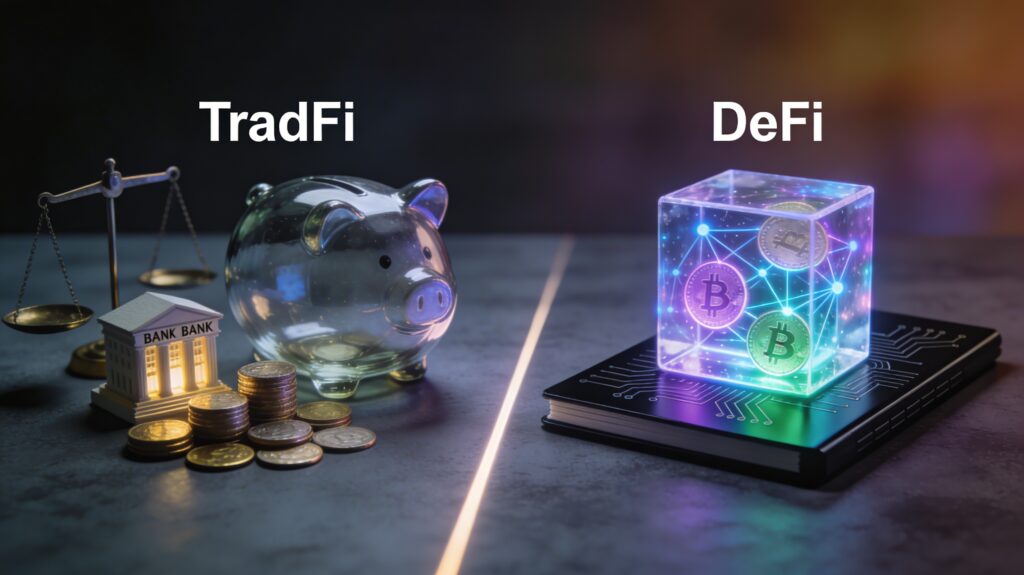
DeFi vs TradFi… two terms that ignite passionate debate across the financial landscape. On one side, proponents herald decentralized finance as a revolutionary, transparent, and inclusive future. On the other, traditional finance stands as a bastion of stability, regulation, and established trust. Rarely do these discussions offer a calm, clear comparison, instead often devolving into tribalism and strong, unsubstantiated opinions.
This article isn’t here to declare a winner or to persuade you to join one camp over the other. Instead, it aims to equip you with the mental framework to objectively compare DeFi vs TradFi across several key dimensions. By the end, you’ll understand how to evaluate each system’s strengths, weaknesses, and inherent trade-offs, allowing you to make informed decisions without falling for the pervasive hype or succumbing to undue fear. We’ll dissect access, transparency, risk, user experience, and regulation, providing a balanced perspective that focuses on the current reality, not an idealized future vision.
How to Define DeFi vs TradFi in Plain Language
To compare DeFi vs TradFi effectively, we first need a clear, no-nonsense understanding of what each term actually represents. Forget the jargon and the marketing fluff; let’s break them down to their core components.
DeFi (Decentralized Finance) refers to financial applications and services built on public, decentralized blockchains, primarily Ethereum, but increasingly other networks as well. The key characteristic here is “decentralized.” This means there’s no central authority – no bank, no government, no company – controlling the system. Instead, operations are governed by code (smart contracts) and often by a community of users holding governance tokens. Think of it as a global, open-source financial system where transactions are recorded on an immutable ledger, and anyone with an internet connection can participate, often pseudonymously. Services range from lending and borrowing to trading, insurance, and even derivatives, all operating without intermediaries.
TradFi (Traditional Finance), conversely, encompasses the established, regulated financial institutions and markets that have dominated the global economy for centuries. This includes commercial banks, investment banks, stock exchanges, insurance companies, payment processors, and regulatory bodies. TradFi operates within a framework of laws, regulations, and oversight designed to protect consumers and maintain systemic stability. Access to TradFi services typically requires identity verification (KYC – Know Your Customer), adherence to jurisdictional rules, and interaction with centralized entities that hold and manage your assets.
When we discuss DeFi vs TradFi, it’s crucial to anchor our comparison in their current realities, not speculative futures or theoretical ideals. Both systems have inherent design philosophies that lead to distinct operational models, user experiences, and risk profiles. Understanding these foundational differences is the first step toward an unbiased evaluation.
How to Compare Access and Inclusion in DeFi vs TradFi
One of the most touted benefits of DeFi is its promise of universal access and financial inclusion. But how does this stack up against TradFi in the real world? Let’s look at who can realistically access each system today.
Traditional Finance, while seemingly ubiquitous in developed nations, is far from universally accessible. Barriers to entry are numerous:
- Know Your Customer (KYC) and Anti-Money Laundering (AML) Regulations: These legal requirements necessitate identity verification, often involving government-issued IDs, proof of address, and sometimes even proof of income. For billions globally without official documentation, or those in regions with unstable governance, these are insurmountable hurdles.
- Geographic Restrictions: Banks and financial institutions operate within national and international regulatory frameworks, often limiting services to residents of specific countries or regions. Cross-border access can be complex, expensive, and slow.
- Minimum Balance Requirements: Many traditional accounts and investment products come with minimum deposit thresholds, effectively locking out individuals with limited capital.
- Documentation and Credit History: Applying for loans, mortgages, or even some basic accounts often requires extensive documentation and a verifiable credit history, which many “unbanked” or “underbanked” individuals lack.
- Connectivity: While less of a barrier in urban areas, remote regions may still lack the physical branches or reliable internet access needed for TradFi services.
The result is a significant portion of the global population — estimated at 1.7 billion unbanked adults — who are excluded from the formal financial system. Even for those who are “banked,” many are “underbanked,” meaning they have limited access to credit, insurance, or affordable financial services.
DeFi, in theory, offers a stark contrast. Since it’s built on public blockchains, anyone with an internet connection and a compatible device (smartphone, computer) can create a wallet and interact with decentralized applications. There are typically no KYC requirements to open a DeFi wallet, no minimum balance to use a lending protocol, and no geographic restrictions beyond what a specific dapp might voluntarily impose. This opens up financial services to:
- The Unbanked and Underbanked: Individuals in developing nations or conflict zones, often excluded from TradFi, can access savings, lending, and remittance services.
- Cross-Border Transactions: DeFi facilitates peer-to-peer value transfer globally, often at lower costs and faster speeds than traditional banking rails.
However, DeFi also introduces its own set of significant barriers, often overlooked by its most ardent proponents:
- Technical Complexity: Setting up a wallet, understanding seed phrases, managing gas fees, and navigating various protocols requires a significant degree of technical literacy. It’s not a user-friendly experience for the average person today.
- Connectivity and Device Access: While less restrictive than physical branches, reliable internet and a compatible device are still prerequisites.
- Digital Literacy: The concepts inherent in blockchain (private keys, smart contracts, impermanent loss) are foreign and often intimidating to those new to the space.
- Language Barriers: While interfaces are improving, many DeFi applications are still primarily in English, limiting global reach.
For the average user in a developed country, TradFi often feels easier and safer due to established interfaces and customer support. For the truly unbanked or those in regions with restrictive financial systems, DeFi offers a compelling alternative, but one that demands a steep learning curve and carries significant risks (which we’ll cover next). When comparing DeFi vs TradFi on access, it’s a nuanced picture of theoretical openness versus practical usability.
How to Evaluate Transparency and Trust
The concepts of transparency and trust are central to the debate around DeFi vs TradFi, yet they are understood and achieved through vastly different mechanisms in each system.
In DeFi, transparency is often hailed as a core tenet. Transactions are recorded on a public blockchain, meaning anyone can view the entire transaction history of any wallet address. This “on-chain data” includes every transfer of assets, every loan taken, every collateral added, and every liquidation. The code governing smart contracts is also typically open-source, allowing anyone to audit its logic. This level of transparency is unprecedented in traditional finance. You can, for instance, see the total value locked in a lending protocol, the interest rates, and even the largest lenders and borrowers (though their real-world identities remain pseudonymous).
However, this transparency has crucial caveats. While the transactions are transparent, the meaning of those transactions, especially in complex protocols, can be effectively opaque.
- Complexity: Understanding what a specific smart contract does, how different protocols interact, or the real risks embedded in a highly composable DeFi ecosystem (where one protocol builds on another) requires deep technical expertise. For the average user, looking at raw on-chain data is like trying to read an encrypted message.
- Pseudonymity: While addresses are public, the real-world identities behind them are not (unless voluntarily disclosed or linked through external means). This makes accountability challenging when things go wrong.
- Information Asymmetry: While data is public, sophisticated actors often have better tools and understanding to interpret it, creating an information advantage.
In TradFi, transparency operates on a different model. Your individual bank account balance and transaction history are private, known only to you and the bank (and relevant regulatory bodies). Bank ledgers are opaque to the public. You cannot see the bank’s internal loan book, its credit decisions, or the full details of its balance sheet beyond what’s mandated for public reporting.
TradFi relies on a framework of regulation, brand reputation, and deposit insurance to engender trust.
- Regulation: Governments and central banks impose strict rules on financial institutions regarding capital adequacy, risk management, consumer protection, and reporting. These regulations are designed to prevent systemic failures and protect customer funds.
- Deposit Insurance: In many countries, government-backed schemes (like FDIC in the US or FSCS in the UK) insure customer deposits up to a certain amount, guaranteeing that even if a bank fails, depositors will get their money back. This is a powerful trust mechanism.
- Brand and History: Established banks have decades, sometimes centuries, of history and brand building, fostering a sense of reliability and stability. You trust your bank because it has been there, seemingly unshaken, for a long time.
- Legal Recourse: If a TradFi institution makes an error or acts improperly, there are established legal avenues for redress, from customer service complaints to regulatory investigations and lawsuits.
When evaluating transparency and trust in DeFi vs TradFi, it boils down to: Do you trust code and open data, or do you trust institutions and regulators? DeFi offers verifiable on-chain transparency but lacks the human accountability and consumer protections of TradFi. TradFi offers privacy for individual accounts and systemic trust through regulation and insurance, but its internal operations remain largely opaque to the public. For most people, the familiar safety net and legal recourse of TradFi still represent a more tangible form of trust.
How to Think About Stability and Risk in DeFi vs TradFi
Understanding stability and risk is paramount when comparing DeFi vs TradFi, as both systems carry inherent dangers, albeit of different kinds. Dismissing one as “perfectly safe” or the other as “inherently dangerous” is naive and unhelpful.
Risks in DeFi:
DeFi, by its very nature, is a nascent and experimental field, leading to several unique and often amplified risks:
- Volatility: The underlying assets in DeFi (cryptocurrencies) are notoriously volatile. A 20-30% price swing in a day is not uncommon. This volatility impacts collateralized loans, liquidity pools, and the overall value of assets held in DeFi protocols.
- Smart Contract Risk: DeFi protocols are run by smart contracts – code deployed on a blockchain. If this code contains bugs, vulnerabilities, or is exploited by malicious actors, users can lose all their funds. Despite audits, smart contract hacks and exploits are a recurring issue.
- Platform Risk/Rug Pulls: Many DeFi projects are launched by anonymous teams. There’s a risk of “rug pulls,” where developers abandon a project and abscond with user funds. Even legitimate projects can suffer from poor management, economic exploits, or unexpected failures.
- Liquidation Risk: In over-collateralized lending protocols, if the value of your collateral drops below a certain threshold, it can be automatically liquidated to repay your loan, often incurring penalties.
- Impermanent Loss: A risk specific to providing liquidity to automated market makers (AMMs), where the value of your deposited assets can decline relative to simply holding them, especially during periods of high volatility.
- Regulatory Risk: The regulatory landscape for DeFi is still evolving. Future regulations could impact the legality, accessibility, or economic viability of certain protocols, potentially leading to asset freezes or forced shutdowns.
- Oracle Risk: Many DeFi protocols rely on “oracles” to feed real-world data (like asset prices) into smart contracts. If an oracle feed is compromised or provides incorrect data, it can lead to significant losses.
- Key Management Risk: Users are solely responsible for managing their private keys/seed phrases. Loss of these keys means permanent loss of funds; compromise means theft.
Risks in TradFi:
While often perceived as “safe,” TradFi is not without its own set of systemic and individual risks:
- Credit Risk: The risk that a borrower (individual, company, or government) will default on their debt. Banks manage this, but widespread defaults can lead to financial instability.
- Bank Run Risk: Although largely mitigated by deposit insurance, the risk that a large number of customers will simultaneously withdraw their deposits, forcing a bank into insolvency. Historically, this has been a major cause of financial crises.
- Systemic Risk: The risk that the failure of one major financial institution could trigger a cascading failure across the entire financial system. The 2008 global financial crisis is a stark reminder of this.
- Inflation Risk: While not unique to TradFi, the value of fiat currency held in traditional accounts can be eroded by inflation over time, especially if interest rates are low.
- Cybersecurity Risk: Banks are constant targets for cyberattacks. While they invest heavily in security, data breaches and account compromises still occur, leading to identity theft or financial loss for customers.
- Operational Risk: Human error, fraud by insiders, or failures in internal systems can lead to financial losses for institutions and their customers.
- Political and Geopolitical Risk: Government decisions, sanctions, or international conflicts can directly impact financial markets and institutions, potentially leading to asset freezes or economic instability.
Lessons from Failures:
Both systems have seen significant failures. In DeFi, we’ve witnessed numerous smart contract exploits leading to millions, sometimes billions, in losses (e.g., flash loan attacks, re-entrancy bugs, bridge hacks). Major stablecoin de-pegs and the collapse of large centralized crypto entities (e.g., FTX, Terra/Luna, Celsius) have highlighted the interconnectedness and fragility of parts of the crypto ecosystem, often due to poor risk management, opaque practices, or outright fraud, despite the underlying “decentralized” nature of some components. These events teach us that decentralization alone doesn’t eliminate all forms of risk, especially those related to human behavior, economic design, and concentrated power within a system.
In TradFi, the 2008 financial crisis showed the devastating impact of unregulated derivatives, subprime lending, and systemic risk, leading to government bailouts and a global recession. Bank failures, though less common now due to improved regulation and deposit insurance, still occur (e.g., Silicon Valley Bank, Signature Bank in 2023), reminding us that even regulated institutions can face liquidity crises. These failures underscore the importance of robust regulation, oversight, and consumer protection mechanisms.
When comparing DeFi vs TradFi on stability and risk, it’s clear: DeFi offers transparency of transactions but often obscures the complexity and novelty of its risks, placing the onus entirely on the user. TradFi, while having its own systemic risks, uses regulation and insurance to absorb and redistribute much of the individual user risk, creating a perception (and often reality) of greater stability for the average consumer.
How to Compare User Experience and Convenience
For the average person, the “feel” of interacting with financial services is a major determinant of adoption. When we compare user experience (UX) and convenience in DeFi vs TradFi, the differences are stark and often define current preferences.
Traditional Finance (TradFi) UX:
TradFi’s user experience has evolved over decades to prioritize ease of use, familiarity, and a sense of security.
- Login/Password Recovery: Most people are familiar with logging into online banking with a username and password. If you forget your password, there’s a clear, established recovery process involving email, phone verification, or even visiting a branch.
- Customer Support: Banks offer multiple channels for support: phone lines with human agents, email, online chat, and physical branches. If you have a problem, you know who to call or where to go.
- Familiar Interfaces: Online banking portals and mobile apps are generally intuitive, with clear menus for checking balances, paying bills, transferring money, and managing cards.
- Error Forgiveness: If you make a mistake (e.g., transfer to the wrong account number), there are often mechanisms for recalling funds or disputing transactions.
- Insurance and Guarantees: The knowledge that deposits are insured and that there are legal protections provides a strong sense of safety, even if the underlying technology is opaque.
- Integration: TradFi is deeply integrated into daily life – direct deposits, automatic bill payments, credit/debit cards for purchases, mortgages, and loans are all seamless for most users.
Decentralized Finance (DeFi) UX:
DeFi, in contrast, is still in its early stages of UX development. While improving rapidly, it presents a significantly higher bar for the average user.
- Wallets and Seed Phrases: The primary gateway to DeFi is a cryptocurrency wallet (e.g., MetaMask, Ledger). Users are solely responsible for managing their “seed phrase” (a list of words that acts as the master key to their funds). Losing this phrase means losing all assets, irrevocably. Sharing it means losing all assets to theft. There is no “forgot password” button in DeFi.
- Gas Fees: Every transaction on a blockchain (sending tokens, interacting with a smart contract) incurs a “gas fee” paid to network validators. These fees can be unpredictable, especially during periods of high network congestion, and can sometimes exceed the value of the transaction itself, making micro-transactions impractical.
- Technical Jargon: DeFi interfaces are often replete with terms like “slippage,” “impermanent loss,” “APY vs. APR,” “collateralization ratio,” and “staking,” which are alien to newcomers.
- Lack of Customer Support: There is no central customer service line for DeFi protocols. If a transaction fails, if you send funds to the wrong address, or if you encounter a bug, you are largely on your own. Community forums or project Discord channels are the closest thing to “support,” but they offer no guarantees.
- Irreversible Transactions: Once a transaction is confirmed on a blockchain, it is final. There is no undo button, no chargeback mechanism, and no way to recover funds sent to the wrong address.
- Security Responsibility: Users bear full responsibility for their own security – protecting their seed phrase, understanding the risks of connecting their wallet to various dapps, and recognizing phishing attempts. There’s no bank to reimburse you if your wallet is compromised.
- Interoperability Challenges: While DeFi is composable, moving assets between different blockchains or even different layers (e.g., Layer 1 to Layer 2) can be complex, involving bridges and varying transaction speeds/fees.
For a normal person today, TradFi undeniably feels easier and safer. The established infrastructure, familiar processes, robust customer support, and inherent consumer protections of traditional banks provide a comfort level that DeFi simply cannot match yet. While DeFi offers unparalleled control and self-custody, this comes at the cost of a significantly steeper learning curve, greater personal responsibility, and a much less forgiving user experience. The convenience of TradFi, backed by its safety nets, still wins out for the vast majority of daily financial needs.
How Regulation Shapes DeFi vs TradFi
Regulation is perhaps the most fundamental difference shaping the operational realities, risks, and protections offered by DeFi vs TradFi. It’s what gives TradFi its perceived stability and what currently leaves DeFi in a state of flux and uncertainty.
TradFi’s Regulatory Environment and Protections:
Traditional finance operates within a dense web of laws and regulations enforced by government bodies (e.g., SEC, FDIC, Federal Reserve in the US; FCA, PRA in the UK; national central banks globally). This regulatory framework is designed to achieve several critical objectives:
- Consumer Protection: Rules ensure that financial institutions act in the best interests of their customers, providing clear disclosures, fair practices, and channels for complaints and redress. Deposit insurance schemes (like FDIC) directly protect customer funds up to a certain limit in case of bank failure.
- Systemic Stability: Regulations on capital adequacy, liquidity, and risk management prevent reckless behavior by institutions that could trigger broader financial crises. Stress tests ensure banks can withstand adverse economic conditions.
- Anti-Money Laundering (AML) and Counter-Terrorism Financing (CTF): KYC (Know Your Customer) rules require banks to verify the identity of their customers, preventing illicit activities.
- Market Integrity: Regulations govern trading practices, prevent market manipulation, and ensure fair and orderly markets.
- Privacy: Laws like GDPR (Europe) or various data protection acts dictate how financial institutions handle and protect customer personal data.
These regulations mean that if you deposit money in a bank, you have legal protections, recourse if something goes wrong, and the assurance that the institution is subject to external oversight. This framework creates a high degree of trust and predictability for everyday users and investors.
DeFi’s Evolving Regulatory Landscape:
DeFi, by its decentralized and global nature, presents significant challenges for traditional regulatory approaches. It largely operates in a gray area, with regulators worldwide grappling with how to classify and oversee it.
- Lack of Clear Classification: Is a lending protocol a bank? Is a governance token a security? Is a stablecoin a currency? Different jurisdictions are taking different approaches, leading to fragmentation and uncertainty.
- Regulatory Arbitrage: The global nature of DeFi means projects can try to operate from jurisdictions with more favorable or lax regulations, creating challenges for enforcement.
- Technological Challenges: Regulating smart contracts and decentralized autonomous organizations (DAOs) is inherently difficult. Who is liable when code is law? How do you enforce KYC on a permissionless blockchain?
- Current Approaches:
- Treating stablecoins as regulated financial instruments: Many jurisdictions are moving to regulate stablecoin issuers, requiring reserves, audits, and licensing (e.g., MiCA in Europe, proposed legislation in the US).
- Focusing on “on-ramps” and “off-ramps”: Centralized exchanges that convert fiat to crypto and vice versa are typically regulated as money service businesses, subject to KYC/AML rules. This creates a choke point for regulators.
- Targeting centralized components: Regulators may focus on entities that provide interfaces, front-ends, or significant control over ostensibly decentralized protocols.
- Applying existing laws: In some cases, existing securities or banking laws are being stretched to fit DeFi protocols, leading to enforcement actions against projects deemed to be offering unregistered securities or operating as unlicensed financial institutions.
- Developing new frameworks: Some countries are exploring bespoke regulatory frameworks for digital assets and DeFi.
Why Regulation Matters for Everyday Users and Investors:
The presence or absence of regulation has profound implications:
- For TradFi Users: Regulation provides a safety net. Your deposits are insured, your personal data is protected, and you have legal recourse if a bank acts negligently or fraudulently. This fosters confidence and reduces individual risk.
- For DeFi Users: The lack of clear regulation means you have fewer protections. There’s no deposit insurance for your crypto assets, limited legal recourse if a protocol fails or is exploited, and often no central entity to hold accountable. This places the full burden of due diligence and risk management squarely on the user.
- Market Maturity: Predictable regulation could foster greater institutional adoption and bring more stability to DeFi, but overly restrictive regulation could stifle innovation or drive activity offshore.
The comparison of DeFi vs TradFi on regulation highlights a fundamental trade-off: TradFi offers robust consumer protection and systemic stability at the cost of centralized control and sometimes slower innovation. DeFi offers innovation and censorship resistance but leaves users exposed to significant risks due to the absence of a comparable regulatory safety net. For most investors, the protections afforded by regulation in TradFi are a non-negotiable requirement.
How to Decide Where DeFi Might Make Sense for You (If at All)
After dissecting the core differences, the practical question remains: Where might DeFi offer a genuine advantage, and where does TradFi remain the undisputed champion? For most people, a balanced perspective, rather than an “all-in” approach, is the most sensible path.
Scenarios Where DeFi May Offer Real Benefits:
While not for the faint of heart or the financially unsophisticated, certain use cases highlight DeFi’s unique strengths:
- On-Chain Stablecoin Savings in Specific Contexts: For individuals in countries with high inflation, capital controls, or unstable banking systems, holding savings in a dollar-pegged stablecoin on a decentralized protocol can offer a degree of protection against local currency devaluation and provide a pathway to preserve purchasing power. The yields offered can also be significantly higher than traditional savings accounts, though this comes with higher risk.
- Specific Cross-Border Use Cases: For remittances or international business transactions, DeFi can bypass traditional banking intermediaries, potentially offering faster settlement times and lower fees, especially for larger sums or to regions underserved by traditional finance.
- Access to Credit Without Traditional Gatekeepers: In theory, DeFi lending protocols allow individuals to borrow against their crypto assets without needing a credit score or going through a bank. This can be beneficial for those excluded from TradFi credit markets, though it requires significant crypto collateral and carries liquidation risk.
- Yield Generation for Crypto Holders: For those already holding significant amounts of cryptocurrency, DeFi offers avenues to earn yield on those assets through lending, staking, or providing liquidity, rather than letting them sit idle.
- Permissionless Innovation and Experimentation: For developers and early adopters, DeFi is a sandbox for financial innovation, allowing for the creation of novel financial products and services without needing permission from traditional gatekeepers.
Scenarios Where TradFi Is Still Clearly Better:
For the vast majority of everyday financial needs, TradFi remains the superior, safer, and more convenient choice:
- Standard Savings Accounts and Insured Deposits: For storing your primary savings, emergency funds, or any money you cannot afford to lose, TradFi’s insured deposits offer unparalleled safety. The peace of mind from government-backed insurance is invaluable and unmatched in DeFi.
- Mortgages and Large Secured Loans: Obtaining a mortgage for a home or a substantial loan for a business requires the complex underwriting, legal frameworks, and long-term stability that only traditional banks can provide. DeFi’s collateralized lending is ill-suited for these long-duration, high-value, real-world asset-backed loans.
- Everyday Payments and Consumer Spending: Using debit cards, credit cards, or established payment apps (e.g., Apple Pay, Venmo) for daily purchases is seamless, secure, and widely accepted. DeFi payments are still clunky, slow, and expensive by comparison.
- Retirement Planning and Long-Term Investing: Diversified portfolios managed by financial advisors, tax-advantaged retirement accounts (e.g., 401ks, IRAs), and access to a wide range of regulated securities are core to TradFi and essential for long-term wealth building.
- Insurance: From health to auto to life insurance, TradFi offers a mature, regulated industry with clear policy terms and legal recourse, providing critical protection against life’s uncertainties. DeFi insurance solutions are nascent and limited in scope.
- Fiat On/Off Ramps: To convert your local currency into crypto and vice versa, you almost always need a regulated centralized exchange or traditional bank account, making TradFi an unavoidable gateway.
A Mixed Approach or Cautious Experimentation:
For most crypto-curious readers, a pragmatic approach is to leverage the strengths of both systems. This might mean:
- Keeping the bulk of your essential funds and long-term investments in insured TradFi accounts.
- Experimenting with a small, disposable portion of your capital in DeFi to understand its mechanics, potential, and risks firsthand.
- Using DeFi for specific niche purposes where it offers a clear, proven advantage, such as certain cross-border transfers or earning yield on existing crypto holdings, but always with a full understanding of the associated risks.
The decision of where to engage with DeFi vs TradFi is deeply personal, dependent on your risk tolerance, technical proficiency, financial goals, and geographic location. For many, a “cautious and diversified” approach is far more realistic than going “all in” on either.
Conclusion: How to Keep a Clear Head About DeFi vs TradFi
The journey through DeFi vs TradFi reveals two vastly different financial paradigms, each with compelling strengths and undeniable weaknesses. It’s easy to get swept up in the rhetoric of either side, but a clear head demands an objective assessment of their fundamental trade-offs.
Here’s a quick recap of the key comparison points:
- Access: DeFi offers theoretical permissionless access but faces practical technical barriers. TradFi offers broad access in developed economies but excludes billions due to KYC, geography, and documentation.
- Transparency & Trust: DeFi offers on-chain transparency but lacks human accountability and consumer protection. TradFi offers privacy for individual accounts and systemic trust through regulation and insurance, despite opaque internal operations.
- Stability & Risk: DeFi bears significant risks from volatility, smart contract vulnerabilities, and nascent regulatory frameworks. TradFi carries systemic risks, but these are largely mitigated for individual users by robust regulation and deposit insurance.
- User Experience: TradFi excels in user-friendliness, established support, and error forgiveness. DeFi demands high technical literacy, places full responsibility on the user, and has a steep learning curve.
- Regulation: TradFi operates within a comprehensive regulatory framework that ensures consumer protection and systemic stability. DeFi is largely unregulated, leaving users exposed with limited recourse.
Ultimately, DeFi vs TradFi should be viewed as tools, not as religions. Each serves different purposes and excels in different contexts. TradFi, with its established infrastructure, regulatory safeguards, and consumer protections, remains the bedrock for most people’s everyday financial needs, offering unparalleled stability and convenience for the lion’s share of financial activities. DeFi, on the other hand, represents a frontier of innovation, offering permissionless access, censorship resistance, and new financial primitives for those willing to navigate its complexities and inherent risks.
The future will likely see elements of both systems converge or coexist. For now, approach both with a critical eye, understand their distinct value propositions and dangers, and make choices that align with your personal risk tolerance and financial literacy, rather than succumbing to the hype or fear that so often clouds the conversation.